


Page 84 - (DK Eyewitness) Travel Guide - Hungary
P. 84
82 BUD APEST AREA B Y AREA AROUND P ARLIA MENT 83
Street-by-Street: Kossuth Square Ferenc Rákóczi II, the prince
of Transylvania, led one of the
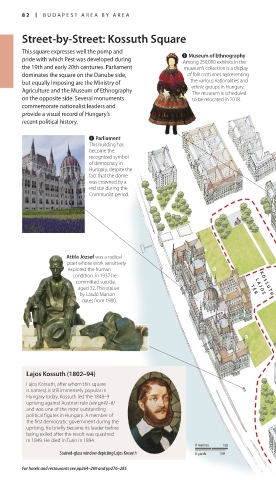
This square expresses well the pomp and 2 Museum of Ethnography earliest uprisings for national
independence against the
pride with which Pest was developed during Among 250,000 exhibits in the Habsburgs in 1703–11. This AROUND
the 19th and early 20th centuries. Parliament museum’s collection is a display bronze equestrian monument, PARLIAMENT
dominates the square on the Danube side, of folk costumes representing standing in front of Parlia
but equally imposing are the Ministry of the various nationalities and ment, was created by Danube
János Pásztor in 1937.
eth nic groups in Hungary.
Agriculture and the Museum of Ethnography The museum is scheduled CENTRAL
PEST
on the opposite side. Several monuments to be relocated in 2018. Locator Map
commemorate nationalist leaders and See Street Finder maps 1 & 2
provide a visual record of Hungary’s
recent political history.
1 Parliament
This building has
become the
recognized symbol
of democracy in
Hungary, despite the
fact that the dome
was crowned by a
red star during the 3 Ministry of Agriculture
Communist period. A massive Corinthian colonnade
supporting an entablature
lends this Neo-Classical
building a dignified character.
This monument to
Imre Nagy symbolizes
the pro-reform Communist
prime minister who rose
up with the people against
Attila Jòzsef was a radical Soviet rule in 1956 – a
poet whose work sensitively protest that cost him his
explored the human life two years later.
condition. In 1937 he
committed suicide, K O S S U T H
aged 32. This statue T É R L A J O S
by László Marton
T É R
L A J O S
K O S S U T H
dates from 1980.
Lajos Kossuth (1802–94)
Lajos Kossuth, after whom this square The former headquarters
is named, is still immensely popular in of Hun garian TV, this elegant
Hungary today. Kossuth led the 1848–9 Secessionist building was
uprising against Austrian rule (see pp42–6) designed by Ignác Alpár and
and was one of the most outstanding constructed in 1905. It origi nally
political figures in Hungary. A member of housed the Stock Exchange.
the first democratic govern ment during the
uprising, he briefly became its leader before
being exiled after the revolt was quashed
in 1849. He died in Turin in 1894.
0 metres 150 Plaque commemorating Key
Stained-glass window depicting Lajos Kossuth 0 yards 150 Brigadier Woroniecki, hero
of the uprising of 1848–9 Suggested route
For hotels and restaurants see pp264–269 and pp276–285
082-083_EW_Hungary.indd 82 18/09/17 3:37 pm 082-083_EW_Hungary.indd 83 18/09/17 3:37 pm

