


Page 40 - Tagalog for Beginners: An Introduction to Filipino, the National Language of the Philippines
P. 40
Kami                                             We

                         The  first  person  exclusive  plural,  kami,  can  be  used  by  one  person
                     speaking, referring to himself/herself and his/her companions; or by several
                     people  speaking  together  and  talking  only  about  themselves.  The  word
                     “exclusive” means that when using this pronoun, the speaker/s are referring
                     exclusively  to  himself/herself  and  his/her  companions,  and  not  to  the
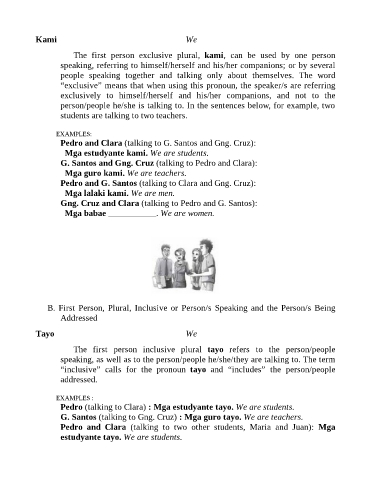
                     person/people he/she is talking to. In the sentences below, for example, two
                     students are talking to two teachers.


                    EXAMPLES:
                     Pedro and Clara (talking to G. Santos and Gng. Cruz):
                       Mga estudyante kami. We are students.
                     G. Santos and Gng. Cruz (talking to Pedro and Clara):
                       Mga guro kami. We are teachers.
                     Pedro and G. Santos (talking to Clara and Gng. Cruz):
                       Mga lalaki kami. We are men.
                     Gng. Cruz and Clara (talking to Pedro and G. Santos):
                       Mga babae ___________. We are women.


                 B. First Person, Plural, Inclusive or Person/s Speaking and the Person/s Being
                     Addressed

             Tayo                                             We

                         The  first  person  inclusive  plural  tayo  refers  to  the  person/people

                     speaking, as well as to the person/people he/she/they are talking to. The term
                     “inclusive”  calls  for  the  pronoun  tayo  and  “includes”  the  person/people
                     addressed.


                    EXAMPLES :
                     Pedro (talking to Clara) : Mga estudyante tayo. We are students.
                     G. Santos (talking to Gng. Cruz) : Mga guro tayo. We are teachers.
                     Pedro  and  Clara  (talking  to  two  other  students,  Maria  and  Juan):  Mga

                     estudyante tayo. We are students.

