


Page 75 - (DK Eyewitness) Travel Guide - Chicago
P. 75
NOR TH SIDE 73
These one-room structures,
costing the City about $100
each, were transported on
wagons to charred lots,
providing fire victims with
instant lodging.
The shanties were later
replaced with permanent
wooden cottages, constructed
before an 1874 city ordinance
prohibited the building of
wooden structures. The high
basements and raised front
staircases typical of these
cottages were designed
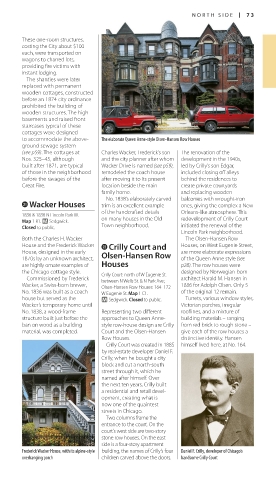
to accommodate the above- The elaborate Queen Anne-style Olsen-Hansen Row Houses
ground sewage system
(see p59). The cottages at Charles Wacker, Frederick’s son The renovation of the
Nos. 325–45, although and the city planner after whom development in the 1940s,
built after 1871, are typical Wacker Drive is named (see p59), led by Crilly’s son Edgar,
of those in the neighborhood remodeled the coach house included closing off alleys
before the ravages of the after moving it to its present behind the residences to
Great Fire. location beside the main create private courtyards
family home. and replacing wooden
No. 1838’s elaborately carved balconies with wrought-iron
a Wacker Houses trim is an excellent example ones, giving the complex a New
of the handcrafted details Orleans-like atmosphere. This
1836 & 1838 N Lincoln Park W.
Map 1 B1. q Sedgwick. on many houses in the Old redevelopment of Crilly Court
Closed to public. Town neighborhood. initiated the renewal of the
Lincoln Park neighborhood.
Both the Charles H. Wacker The Olsen-Hansen Row
House and the Frederick Wacker s Crilly Court and Houses, on West Eugenie Street,
House, designed in the early Olsen-Hansen Row are more elaborate expressions
1870s by an unknown architect, of the Queen Anne style (see
are highly ornate examples of Houses p28). The row houses were
the Chicago cottage style. Crilly Court: north of W Eugenie St. designed by Norwegian-born
Commissioned by Frederick between N Wells St. & N Park Ave.; architect Harald M. Hansen in
Wacker, a Swiss-born brewer, Olsen-Hansen Row Houses: 164–172 1886 for Adolph Olsen. Only 5
No. 1836 was built as a coach W Eugenie St. Map 1 C1. of the original 12 remain.
house but served as the q Sedgwick. Closed to public. Turrets, various window styles,
Wacker’s temporary home until Victorian porches, irregular
No. 1838, a wood-frame Representing two different rooflines, and a mixture of
structure built just before the approaches to Queen Anne- building materials – ranging
ban on wood as a building style row-house design are Crilly from red brick to rough stone –
material, was completed. Court and the Olsen-Hansen give each of the row houses a
Row Houses. distinctive identity. Hansen
Crilly Court was created in 1885 himself lived here, at No. 164.
by real-estate developer Daniel F.
Crilly, when he bought a city
block and cut a north-south
street through it, which he
named after himself. Over
the next ten years, Crilly built
a residential and retail devel-
opment, creating what is
now one of the quaintest
streets in Chicago.
Two columns frame the
entrance to the court. On the
court’s west side are two-story
stone row houses. On the east
side is a four-story apartment
Frederick Wacker House, with its alpine-style building, the names of Crilly’s four Daniel F. Crilly, developer of Chicago’s
overhanging porch children carved above the doors. handsome Crilly Court
072-073_EW_Chicago.indd 73 13/07/16 2:59 pm

