


Page 79 - (DK Eyewitness) Travel Guide - Chicago
P. 79
NEAR NOR TH SIDE 77
h International
Originally, each of the proof that patients survived
floors comprised a separate Museum of the procedure. Less grisly
apartment with 15 rooms Surgical Science exhibits include a recreation
(5 for servants) and 9,000 sq ft of a turn-of-the-20th-century
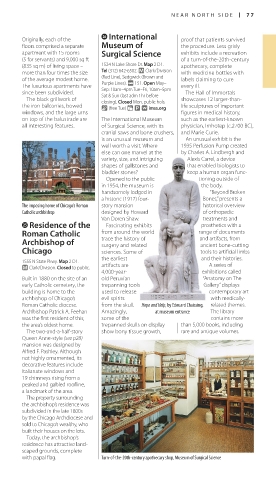
(835 sq m) of living space – 1524 N Lake Shore Dr. Map 2 D1. apothecary, complete
more than four times the size Tel (312) 642-6502. q Clark/Division with medicine bottles with
of the average modest home. (Red Line), Sedgwick (Brown and labels claiming to cure
The luxurious apartments have Purple Lines). @ 151. Open May– every ill.
since been subdivided. Sep: 10am–4pm Tue–Fri, 10am–5pm The Hall of Immortals
Sat & Sun (last adm 1hr before
The black grillwork of closing). Closed Mon, public hols. showcases 12 larger-than-
the iron balconies, bowed & (free Tue) = h ∑ imss.org life sculptures of important
windows, and the large urns figures in medical history,
on top of the balustrade are The International Museum such as the earliest-known
all interesting features. of Surgical Science, with its physician, Imhotep (c.2700 BC),
cranial saws and bone crushers, and Marie Curie.
is an unusual museum and An unusual exhibit is the
well worth a visit. Where 1935 Perfusion Pump created
else can one marvel at the by Charles A. Lindbergh and
variety, size, and intriguing Alexis Carrel, a device
shapes of gallstones and that enabled biologists to
bladder stones? keep a human organ func-
Opened to the public tioning outside of
in 1954, the museum is the body.
handsomely lodged in “Beyond Broken
a historic (1917) four- Bones,” presents a
The imposing home of Chicago’s Roman story mansion historical overview
Catholic archbishop designed by Howard of orthopedic
Van Doren Shaw. treatments and
g Residence of the Fascinating exhibits prosthetics with a
Roman Catholic from around the world range of documents
Archbishop of trace the history of and artifacts, from
surgery and related
ancient bone-cutting
Chicago sciences. Some of tools to artificial limbs
the earliest and their histories.
1555 N State Pkwy. Map 2 D1.
q Clark/Division. Closed to public. artifacts are A series of
4,000-year- exhibitions called
Built in 1880 on the site of an old Peruvian “Anatomy on The
early Catholic cemetery, the trepanning tools Gallery” displays
building is home to the used to release contemporary art
archbishop of Chicago’s evil spirits with medically-
Roman Catholic diocese. from the skull. Hope and Help, by Edouard Chaissing, related themes.
Archbishop Patrick A. Feehan Amazingly, at museum entrance The library
was the first resident of this, some of the contains more
the area’s oldest home. trepanned skulls on display than 5,000 books, including
The two-and-a-half-story show bony tissue growth, rare and antique volumes.
Queen Anne-style (see p28)
mansion was designed by
Alfred F. Pashley. Although
not highly ornamented, its
decorative features include
Italianate windows and
19 chimneys rising from a
peaked and gabled roofline,
a landmark of the area.
The property surrounding
the archbishop’s residence was
subdivided in the late 1800s
by the Chicago Archdiocese and
sold to Chicago’s wealthy, who
built their houses on the lots.
Today, the archbishop’s
residence has attractive land-
scaped grounds, complete
with papal flag. Turn-of-the-20th-century apothecary shop, Museum of Surgical Science
076-077_EW_Chicago.indd 77 13/07/16 2:59 pm

