


Page 106 - Men’s Health - USA (December 2019)
P. 106
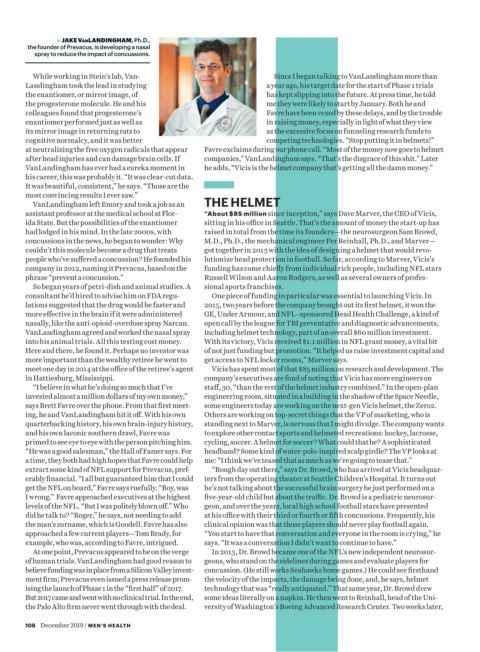
▶ JAKE VANLANDINGHAM, Ph.D.,
          the founder of Prevacus, is developing a nasal
            spray to reduce the impact of concussions.


            While working in Stein’s lab, Van-                                             Since I began talking to VanLandingham more than
         Landingham took the lead in studying                                           a year ago, his target date for the start of Phase 1 trials
         the enantiomer, or mirror image, of                                            has kept slipping into the future. At press time, he told
         the progesterone molecule. He and his                                          me they were likely to start by January. Both he and
         colleagues found that progesterone’s                                           Favre have been vexed by these delays, and by the trouble
         enantiomer performed just as well as                                           in raising money, especially in light of what they view
         its mirror image in returning rats to                                          as the excessive focus on funneling research funds to
         cognitive normalcy, and it was better                                          competing technologies. “Stop putting it in helmets!”
         at neutralizing the free oxygen radicals that appear       Favre exclaims during our phone call. “Most of the money now goes to helmet
         after head injuries and can damage brain cells. If         companies,” VanLandingham says. “That’s the disgrace of this shit.” Later
         VanLandingham has ever had a eureka moment in              he adds, “Vicis is the helmet company that’s getting all the damn money.”
         his career, this was probably it. “It was clear-cut data.
         It was beautiful, consistent,” he says. “Those are the
         most convincing results I ever saw.”
            VanLandingham left Emory and took a job as an           THE HELMET
         assistant professor at the medical school at Flor-         “About $85 million since inception,” says Dave Marver, the CEO of Vicis,
         ida State. But the possibilities of the enantiomer         sitting in his offi  ce in Seattle. That’s the amount of money the start-up has
         had lodged in his mind. In the late 2000s, with            raised in total from the time its founders—the neurosurgeon Sam Browd,
         concussions in the news, he began to wonder: Why           M.D., Ph.D., the mechanical engineer Per Reinhall, Ph.D., and Marver—
         couldn’t this molecule become a drug that treats           got together in 2013 with the idea of designing a helmet that would revo-
         people who’ve suff ered a concussion? He founded his       lutionize head protection in football. So far, according to Marver, Vicis’s
         company in 2012, naming it Prevacus, based on the          funding has come chiefl y from individual rich people, including NFL stars
         phrase “prevent a concussion.”                             Russell Wilson and Aaron Rodgers, as well as several owners of profes-
            So began years of petri-dish and animal studies. A      sional sports franchises.
         consultant he’d hired to advise him on FDA regu-             One piece of funding in particular was essential to launching Vicis. In
         lations suggested that the drug would be faster and        2015, two years before the company brought out its fi rst helmet, it won the
         more eff ective in the brain if it were administered       GE, Under Armour, and NFL–sponsored Head Health Challenge, a kind of
         nasally, like the anti-opioid-overdose spray Narcan.       open call by the league for TBI preventative and diagnostic advancements,
         VanLandingham agreed and worked the nasal spray            including helmet technology, part of an overall $60 million investment.
         into his animal trials. All this testing cost money.       With its victory, Vicis received $1.1 million in NFL grant money, a vital bit
         Here and there, he found it. Perhaps no investor was       of not just funding but promotion. “It helped us raise investment capital and
         more important than the wealthy retiree he went to         get access to NFL locker rooms,” Marver says.
         meet one day in 2014 at the offi  ce of the retiree’s agent   Vicis has spent most of that $85 million on research and development. The
         in Hattiesburg, Mississippi.                               company’s executives are fond of noting that Vicis has more engineers on
            “I believe in what he’s doing so much that I’ve         staff , 30, “than the rest of the helmet industry combined.” In the open-plan
         invested almost a million dollars of my own money,”        engineering room, situated in a building in the shadow of the Space Needle,
         says Brett Favre over the phone. From that fi rst meet-    some engineers today are working on the next-gen Vicis helmet, the Zero2.
         ing, he and VanLandingham hit it off . With his own        Others are working on top-secret things that the VP of marketing, who is
         quarterbacking history, his own brain-injury history,      standing next to Marver, is nervous that I might divulge. The company wants
         and his own laconic southern drawl, Favre was              to explore other contact sports and helmeted recreations: hockey, lacrosse,
         primed to see eye to eye with the person pitching him.     cycling, soccer. A helmet for soccer? What could that be? A sophisticated
         “He was a good salesman,” the Hall of Famer says. For      headband? Some kind of water-polo-inspired scalp girdle? The VP looks at
         a time, they both had high hopes that Favre could help     me: “I think we’ve teased that as much as we’re going to tease that.”
         extract some kind of NFL support for Prevacus, pref-         “Rough day out there,” says Dr. Browd, who has arrived at Vicis headquar-
         erably fi nancial. “I all but guaranteed him that I could   ters from the operating theater at Seattle Children’s Hospital. It turns out
         get the NFL on board,” Favre says ruefully. “Boy, was      he’s not talking about the successful brain surgery he just performed on a
         I wrong.”  Favre approached executives at the highest      fi ve-year-old child but about the traffi  c. Dr. Browd is a pediatric neurosur-
         levels of the NFL. “But I was politely blown off .” Who    geon, and over the years, local high school football stars have presented
         did he talk to? “Roger,” he says, not needing to add       at his offi  ce with their third or fourth or fi fth concussions. Frequently, his
         the man’s surname, which is Goodell. Favre has also        clinical opinion was that those players should never play football again.
         approached a few current players—Tom Brady, for            “You start to have that conversation and everyone in the room is crying,” he
         example, who was, according to Favre, intrigued.           says. “It was a conversation I didn’t want to continue to have.”
            At one point, Prevacus appeared to be on the verge        In 2013, Dr. Browd became one of the NFL’s new independent neurosur-
         of human trials. VanLandingham had good reason to          geons, who stand on the sidelines during games and evaluate players for
         believe funding was in place from a Silicon Valley invest-  concussion. (He still works Seahawks home games.) He could see fi rsthand
         ment fi rm; Prevacus even issued a press release prom-     the velocity of the impacts, the damage being done, and, he says, helmet
         ising the launch of Phase 1 in the “fi rst half” of 2017.   technology that was “really antiquated.” That same year, Dr. Browd drew
         But 2017 came and went with no clinical trial. In the end,   some ideas literally on a napkin. He then went to Reinhall, head of the Uni-
         the Palo Alto fi rm never went through with the deal.      versity of Washington’s Boeing Advanced Research Center. Two weeks later,


         108 December 2019 / MEN’S HEALTH

