


Page 108 - Men’s Health - USA (December 2019)
P. 108
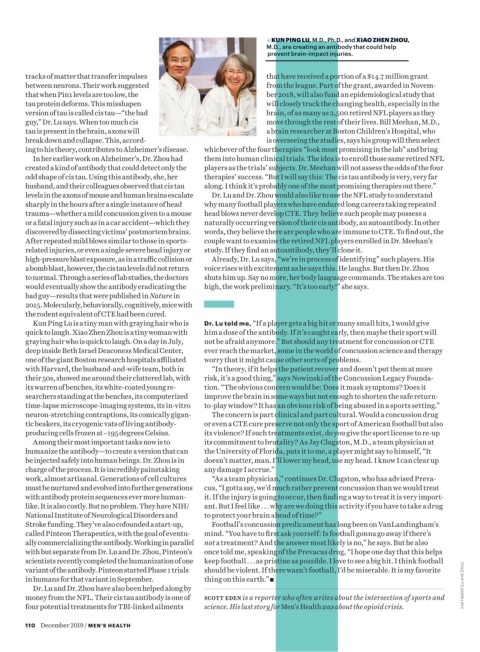
◀ KUN PING LU, M.D., Ph.D., and XIAO ZHEN ZHOU,
                                                                                        M.D., are creating an antibody that could help
                                                                                         prevent brain-impact injuries.


         tracks of matter that transfer impulses                                        that have received a portion of a $14.7 million grant
         between neurons. Their work suggested                                          from the league. Part of the grant, awarded in Novem-
         that when Pin1 levels are too low, the                                         ber 2018, will also fund an epidemiological study that
         tau protein deforms. This misshapen                                            will closely track the changing health, especially in the
         version of tau is called cis tau—“the bad                                      brain, of as many as 2,500 retired NFL players as they
         guy,” Dr. Lu says. When too much cis                                           move through the rest of their lives. Bill Meehan, M.D.,
         tau is present in the brain, axons will                                        a brain researcher at Boston Children’s Hospital, who
         break down and collapse. This, accord-                                         is overseeing the studies, says his group will then select
         ing to his theory, contributes to Alzheimer’s disease.     whichever of the four therapies “look most promising in the lab” and bring
            In her earlier work on Alzheimer’s, Dr. Zhou had        them into human clinical trials. The idea is to enroll those same retired NFL
         created a kind of antibody that could detect only the      players as the trials’ subjects. Dr. Meehan will not assess the odds of the four
         odd shape of cis tau. Using this antibody, she, her        therapies’ success. “But I will say this: The cis tau antibody is very, very far
         husband, and their colleagues observed that cis tau        along. I think it’s probably one of the most promising therapies out there.”
         levels in the axons of mouse and human brains escalate       Dr. Lu and Dr. Zhou would also like to use the NFL study to understand
         sharply in the hours after a single instance of head       why many football players who have endured long careers taking repeated
         trauma—whether a mild concussion given to a mouse          head blows never develop CTE. They  believe such people may possess a
         or a fatal injury such as in a car accident—which they     naturally occurring version of their cis antibody, an autoantibody. In other
         discovered by dissecting victims’ postmortem brains.       words, they believe there are people who are immune to CTE. To fi nd out, the
         After repeated mild blows similar to those in sports-      couple want to examine the retired NFL players enrolled in Dr. Meehan’s
         related injuries, or even a single severe head injury or   study. If they fi nd an autoantibody, they’ll clone it.
         high-pressure blast exposure, as in a traffi  c collision or   Already, Dr. Lu says, “we’re in process of identifying” such players. His
         a bomb blast, however, the cis tau levels did not return   voice rises with excitement as he says this. He laughs. But then Dr. Zhou
         to normal. Through a series of lab studies, the doctors    shuts him up. Say no more, her body language commands. The stakes are too
         would eventually show the antibody eradicating the         high, the work preliminary. “It’s too early!” she says.
         bad guy—results that were published in Nature in
         2015. Molecularly, behaviorally, cognitively, mice with
         the rodent equivalent of CTE had been cured.
            Kun Ping Lu is a tiny man with graying hair who is      Dr. Lu told me, “If a player gets a big hit or many small hits, I would give
         quick to laugh. Xiao Zhen Zhou is a tiny woman with        him a dose ofthe antibody.If it’s caught early, then maybe their sport will
         graying hair who is quick to laugh. On a day in July,      not be afraid anymore.” But should any treatment for concussion or CTE
         deep inside Beth Israel Deaconess Medical Center,          ever reach the market, some in the world of concussion science and therapy
         one of the giant Boston research hospitals affi  liated    worry that it might cause other sorts of problems.
         with Harvard, the husband-and-wife team, both in             “In theory, if it helps the patient recover and doesn’t put them at more
         their 50s, showed me around their cluttered lab, with      risk, it’s a good thing,” says Nowinski of the Concussion Legacy Founda-
         its warren of benches, its white-coated young re-          tion. “The obvious concern would be: Does it mask symptoms? Does it
         searchers standing at the benches, its computerized        improve the brain in some ways but not enough to shorten the safe return-
         time-lapse microscope-imaging systems, its in-vitro        to-play window? It has an obvious risk of being abused in a sports setting.”
         neuron-stretching contraptions, its comically gigan-         The concern is part clinical and part cultural. Would a concussion drug
         tic beakers, its cryogenic vats of living antibody-        or even a CTE cure preserve not only the sport of American football but also
         producing cells frozen at –195 degrees Celsius.            its violence? If such treatments exist, do you give the sport license to re-up
            Among their most important tasks now is to              its commitment to brutality? As Jay Clugston, M.D., a team physician at
         humanize the antibody—to create a version that can         the University of Florida, puts it to me, a player might say to himself, “It
         be injected safely into human beings. Dr. Zhou is in       doesn’t matter, man. I’ll lower my head, use my head. I know I can clear up
         charge of the process. It is incredibly painstaking        any damage I accrue.”
         work, almost artisanal. Generations of cell cultures         “As a team physician,” continues Dr. Clugston, who has advised Preva-
         must be nurtured and evolved into further generations      cus, “I gotta say, we’d much rather prevent concussion than we would treat
         with antibody protein sequences ever more human-           it. If the injury is going to occur, then fi nding a way to treat it is very import-
         like. It is also costly. But no problem. They have NIH/    ant. But I feel like . . . why are we doing this activity if you have to take a drug
         National Institute of Neurological Disorders and           to protect your brain ahead of time?”
         Stroke funding. They’ve also cofounded a start-up,           Football’s concussion predicament has long been on VanLandingham’s
         called Pinteon Therapeutics, with the goal of eventu-      mind. “You have to fi rst ask yourself: Is football gonna go away if there’s
         ally commercializing the antibody. Working in parallel     not a treatment? And the answer most likely is no,” he says. But he also
         with but separate from Dr. Lu and Dr. Zhou, Pinteon’s      once told me, speaking of the Prevacus drug, “I hope one day that this helps
         scientists recently completed the humanization of one      keep football . . . as pristine as possible. I love to see a big hit. I think football
         variant of the antibody. Pinteon started Phase 1 trials    should be violent. If there wasn’t football, I’d be miserable. It is my favorite
         in humans for that variant in September.                   thing on this earth.”
            Dr. Lu and Dr. Zhou have also been helped along by                                                                                           Joel Haskell (Lu and Zhou)
         money from the NFL. Their cis tau antibody is one of       SCOTT EDEN is a reporter who often writes about the intersection of sports and
         four potential treatments for TBI-linked ailments          science. His last story for Men’s Health was about the opioid crisis.


         110 December 2019 / MEN’S HEALTH

