


Page 68 - All About History - Issue 53-17
P. 68
Ancient Olympics


           admitted: “I think you’re happy to put up with   part, irrespective of social status. Indeed, the
           all of this when you think of the splendour of    flamboyant Alcibiades refused to participate in
           the spectacles.”                       any sport except chariot racing, the preserve of
                                                  the rich, because it would mean competing with
           Athletes                               people of a lower class.
                                                   The only other category involved age. There
           Being a masculine religious festival in honour   were a handful of contests for boys: boxing,
           of dead heroes and the great god Zeus, women,   wrestling, the ‘stade’ race, and – for one year only
           with the one exception of the Priestess of   in 628 BCE – the pentathlon. For every other
           Demeter, were forbidden to attend the Games   competition, athletes had to be be adults over
           — though a parallel four-yearly women’s festival   20. A month before the Games began, all were
           was held at Olympia in honour of the goddess   required to gather at Elis, the city that controlled
           Hera. Gender was not the only restriction. No   the Festival. Here, they were compelled to train
           convicted murderer could enter unless they had   and compete in initial heats under the stern
           first undergone a lengthy purification ritual and   watch of the Hellanodikai (‘Judges of the Greeks’),
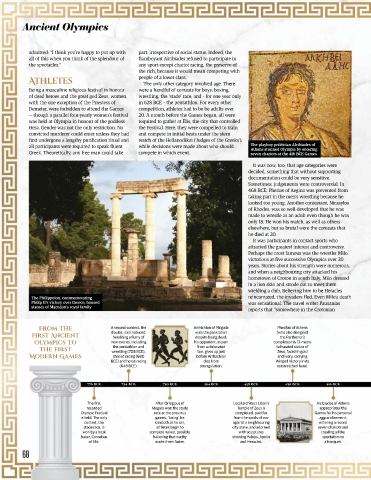
           all participants were required to speak fluent   while decisions were made about who should   The playboy politician Alcibiades of
                                                                                         Athens stunned Olympia by entering
           Greek. Theoretically, any free man could take   compete in which event.       seven chariots at the 416 BCE Games
                                                                                          It was now, too, that age categories were
                                                                                        decided, something that without supporting
                                                                                        documentation could be very sensitive.
                                                                                        Sometimes, judgements were controversial. In
                                                                                        468 BCE, Pherias of Aegina was prevented from
                                                                                        taking part in the men’s wrestling because he
                                                                                        looked too young. Another contestant, Nicasylos
                                                                                        of Rhodes, was so well-developed that he was
                                                                                        made to wrestle as an adult even though he was
                                                                                        only 18. He won his match, as well as others
                                                                                        elsewhere, but so brutal were the contests that
                                                                                        he died at 20.
                                                                                          It was participants in contact sports who
                                                                                        attracted the greatest interest and controversy.
                                                                                        Perhaps the most famous was the wrestler Milo,
                                                                                        victorious at five successive Olympics over 20
                                                                                        years. Stories about his strength were numerous,
                                                                                        and when a neighbouring city attacked his
                                                                                        hometown of Croton in south Italy, Milo dressed
                                                                                        in a lion skin and strode out to meet them
                                                                                        wielding a club. Believing him to be Heracles
            The Philippeion, commemorating                                              reincarnated, the invaders fled. Even Milo’s death
            Philip II’s victory over Greece, housed                                     was sensational. The travel writer Pausanias
            statues of Macedon’s royal family
                                                                                        reports that “somewhere in the Crotonian

               From the                 A second contest, the        Arrhichion of Phigalia       Pheidias of Athens
            first Ancient               diaulos, is introduced,       wins the pankration         (who also designed
                                                                                                   the Parthenon)
                                         heralding a flurry of
                                                                      despite being dead:
             Olympics to                new events, including        his opponent, in pain       completes his 13-metre
                                         the pentathlon and
               the first                wrestling (708 BCE),          from a dislocated           tall seated statue of
                                                                                                  Zeus, faced in gold
                                                                      toe, gives up just
           Modern Games                  chariot racing (680          before Arrhachion            and ivory, carrying
                                        BCE) and horse racing            dies from                Winged Victory in its
                                           (648 BCE).                  strangulation.             outstretched hand.
                                776 BCE     724 BCE       720 BCE        564 BCE       458 BCE       430 BCE        416 BCE

                                The first               After Orisippus of         Local architect Libon’s      Alcibiades of Athens
                               recorded               Megara won the stade          Temple of Zeus is            appropriates the
                             Olympic Festival          race at the previous         completed, paid for         Games for his personal
                             is held. The only          games, ‘losing’ his        from the spoils of war        aggrandisement,
                               contest, the            loincloth as he ran,        against a neighbouring        entering a record
                              stade race, is            athletes begin to          city-state, and adorned       seven chariots and
                              won by a local          compete naked, possibly        with sculptures              treating all the
                             baker, Coroebus           believing that nudity       showing Pelops, Apollo         spectators to
                                of Elis.                made them faster.            and Heracles.                 a banquet.
         68

