


Page 66 - All About History - Issue 53-17
P. 66
Ancient Olympics


                                                                                        Mythology

                                                                                        All classical accounts of the Olympics’ origins
                                                                                        involved mythology. Some maintained that it
                                                                                        was at Olympia that Zeus defeated his father
                                                                                        Cronus and assumed control of gods and mortals.
                                                                                        Others claimed that Heracles established the first
                                                                                        Games to celebrate his victory over the local King
                                                                                        Augeas, who had refused to pay the hero for one
                                                                                        of his twelve labours, cleansing the royal stables.
                                                                                          Still others disagreed. For them, the founder
                                                                                        of the Games was Pelops, an Ionian prince from
                                                                                        Phocaea (modern Foça in Turkey). Learning
                                                                                        that the wealthy Greek King Oenomaeus was
                                                                                        offering his daughter, Hippodamia, in marriage
                                                                                        to whomever beat him in a chariot race, Pelops
                                                                                        was determined to win. Even though he
                                                                                        possessed a team of magical horses, a gift from
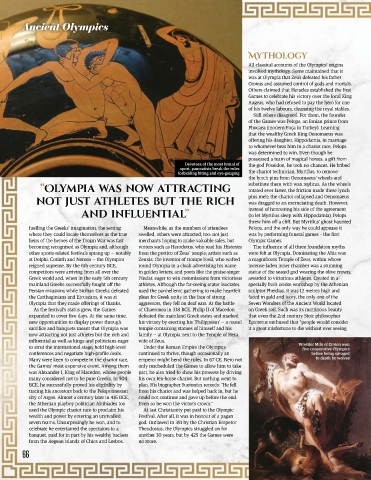
                                                                  Devotees of the most brutal of   the god Poseidon, he took no chances. He bribed
                                                                sport, pancratists break the rules
                                                                forbidding biting and eye-gouging  the chariot technician, Myrtilus, to remove
                                                                                        the lynch pins from Oenomaeus’ wheels and
               “Olympia was now attracting                                              substitute them with wax replicas. As the wheels
                                                                                        rotated ever faster, the friction made these lynch
              not just athletes but the rich                                            pins melt; the chariot collapsed and Oenomaeus
                                                                                        was dragged to an excruciating death. However,
                              and influential”                                          instead of honouring his side of the agreement
                                                                                        (to let Myrtilus sleep with Hippodamia), Pelops
                                                                                        threw him off a cliff. But Myrtilus’ ghost haunted
           fuelling the Greeks’ imagination, the setting   Meanwhile, as the numbers of attendees   Pelops, and the only way he could appease it
           where they could locate themselves as the true   swelled, others were attracted, too: not just   was by performing funeral games – the first
           heirs of the heroes of the Trojan War was fast   merchants hoping to make valuable sales, but   Olympic Games.
           becoming recognised as Olympia and, although   writers such as Herodotus, who read his Histories   The influence of all three foundation myths
           other sports-related festivals sprang up — notably   from the portico of Zeus’ temple; artists such as   were felt at Olympia. Dominating the Altis was
           at Delphi, Corinth and Nemea — the Olympics   Zeuxis, the inventor of trompe l’oeil, who wafted   a magnificent Temple of Zeus, within whose
           reigned supreme. By the 6th century BCE,   round Olympia in a cloak advertising his name   incense-laden inner chamber was a stunning
           competitors were arriving from all over the   in golden letters; and poets like the praise-singer   statue of the seated god wearing the olive crown,
           Greek world and, when in the early 5th century   Pindar, eager to win commissions from victorious   awarded to victorious athletes. Created in a
           mainland Greeks successfully fought off the   athletes. Although the far-seeing orator Isocrates   specially built onsite workshop by the Athenian
           Persian invasions while Sicilian Greeks defeated   used the panhellenic gathering to make heartfelt   sculptor Pheidias, it was 12 metres high and
           the Carthaginians and Etruscans, it was at   pleas for Greek unity in the face of strong   faced in gold and ivory, the only one of the
           Olympia that they made offerings of thanks.   aggressors, they fell on deaf ears. At the battle   Seven Wonders of the Ancient World located
             As the festival’s status grew, the Games   of Chaeronea in 338 BCE, Philip II of Macedon   on Greek soil. Such was its numinous beauty
           expanded to cover five days. At the same time,   defeated the mainland Greek states and marked   that even the 2nd century Stoic philosopher
           new opportunities to display power through   his victory by erecting his ‘Philippeion’ — a round   Epictetus enthused that “people would consider
           sacrifice and banquets meant that Olympia was   temple containing statues of himself and his   it a great misfortune to die without ever seeing
           now attracting not just athletes but the rich and   family — at Olympia next to the Temple of Hera,
           influential as well as kings and politicians eager   wife of Zeus.
                                                                                                          Wrestler Milo of Croton won
           to strut the international stage, hold high-level   Under the Roman Empire the Olympics         five consecutive Olympics
           conferences and negotiate high-profile deals.   continued to thrive, though occasionally an         before being savaged
           Many were keen to compete in the chariot race,   emperor might bend the rules. In 67 CE, Nero not    to death by wolves
           the Games’ most expensive event. Among them   only rescheduled the Games to allow him to take
           was Alexander I, King of Macedon, whose people   part, he also tried to show his prowess by driving
           many considered not to be pure Greeks. In 504   his own ten-horse chariot. But nothing went to
           BCE, he successfully proved his eligibility by   plan. His biographer Suetonius records: “He fell
           tracing his ancestors back to the Peloponnesian   from his chariot and was helped back in, but he
           city of Argos. Almost a century later in 416 BCE,   could not continue and gave up before the end.
           the Athenian playboy politician Alcibiades too   Even so he won the victor’s crown.”
           used the Olympic chariot race to proclaim his   At last Christianity put paid to the Olympic
           wealth and power by entering an unrivalled   Festival. After all, it was in honour of a pagan
           seven teams. Unsurprisingly he won, and to   god. Outlawed in 391 by the Christian Emperor
           celebrate he entertained the spectators to a   Theodosius, the Olympics struggled on for
           banquet, paid for in part by his wealthy backers   another 30 years, but by 425 the Games were
           from the Aegean islands of Chios and Lesbos.   no more.
         66

