


Page 67 - All About History - Issue 53-17
P. 67
Ancient Olympics


        it”. Transported to Constantinople by rapacious   make this sacrifice, was praised for something   who could not afford to stay at the Leonidaion
        Romans, the statue was destroyed by fire in 462,   altogether more prosaic. Legend told that thanks   — a ‘hotel’ built by a far-sighted entrepreneur in
        but we can still appreciate its power: Byzantine   to his sacrifice to the very specifically named   360 BCE — pitched tents or slept rough outside
        iconographers used it as their model for the face   Zeus Who-Banishes-Flies, Zeus Apomuios, he   the sanctuary with little running water and no
        of God.                               caused Olympia to be fly-free.         sanitation, a jostling mêlée of increasingly rank
          Meanwhile, a stone’s throw from Zeus’ temple   Spectators had good reason to be thankful,   bodies. For some, such as Epictetus, the abiding
        to the north, Pelops’ grave-mound was the site   especially since the Games were celebrated in the   memory was “the sunburn and the filth… the
        of one of the festival’s most solemn ceremonies,   scorching heat of August, when conditions could   cacophony, the din, the jostling, the shoving, the
        when a black ram was sacrificed to the dead   be horrendous. For the five days surrounding the   crowding, and so many people, each absorbed
        hero, while Heracles, said to be the first to   new moon, those tens of thousands of spectators,   in doing his own thing”. However, even he


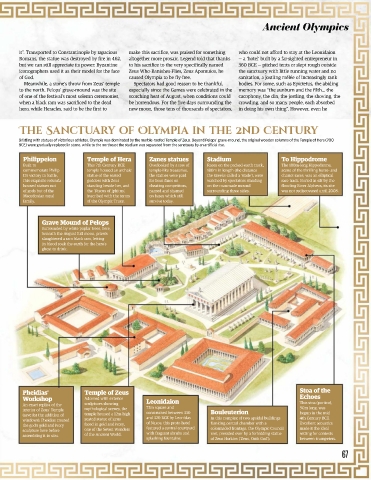
        The Sanctuary of Olympia in the 2nd Century

        Bristling with statues of victorious athletes, Olympia was dominated by the marble-roofed Temple of Zeus. Beyond Pelops’ grave-mound, the original wooden columns of the Temple of Hera (700
        BCE) were gradually replaced in stone, while to the northeast the stadium was separated from the sanctuary by an artificial rise.

         Philippeion            Temple of Hera        Zanes statues       Stadium                   To Hippodrome
         Built to               This 7th Century BCE   Overlooked by a row of   Races on the packed-earth track,   The 180m-long Hippodrome,
         commemorate Philip     temple housed an archaic   temple-like treasuries,   180m in length (the distance   scene of the thrilling horse- and
         II’s victory in battle,   statue of the seated   the statues were paid   the Greeks called a ‘stade’), were   chariot-races, was an elliptical
         this exquisite rotunda   goddess with Zeus   for from fines on   watched by spectators standing   race track. Buried in silt by the
         housed statues not     standing beside her, and   cheating competitors,   on the manmade mound   flooding River Alpheus, its site
         of gods but of the     the ‘Discus of Iphitus’,   named and shamed   surrounding three sides.  was not rediscovered until 2008.
         Macedonian royal       inscribed with the terms   on bases which still
         family.                of the Olympic Truce.  survive today.


                Grave Mound of Pelops
                Surrounded by white poplar trees, here,
                beneath the August full moon, priests
                slaughtered a ram black ram, letting
                its blood soak the earth for the hero’s
                ghost to drink.


         Pheidias’             Temple of Zeus                                                             Stoa of the
         Workshop              Adorned with exterior   Leonidaion                                         Echoes
         An exact replica of the   sculptures showing                                                     This stoa (portico),
         interior of Zeus’ Temple   mythological scenes, the   73m square and   Bouleuterion              90m long, was
         (save for the addition of   temple housed a 12m-high   constructed between 330                   begun in the mid
         windows), Pheidias created   seated statue of Zeus   and 320 BCE by Leonidas   In this complex of two apsidal buildings   4th Century BCE.
         the god’s gold and ivory   faced in gold and ivory,   of Naxos, this proto-hotel   flanking central chamber with a   Excellent acoustics
         sculpture here before   one of the Seven Wonders   featured a central courtyard   colonnaded frontage, the Olympic Council   made it the ideal
         assembling it in situ.  of the Ancient World.  with fragrant shrubs and   met, presided over by a forbidding statue   setting for contests
                                                    splashing fountains.   of Zeus Horkios (‘Zeus, Oath God’).  between trumpeters.
                                                                                                                         67

