


Page 120 - (DK) The Dog Encyclopedia
P. 120
CATALOG OF BREEDS  |  SPITZ-TYPE DOGS


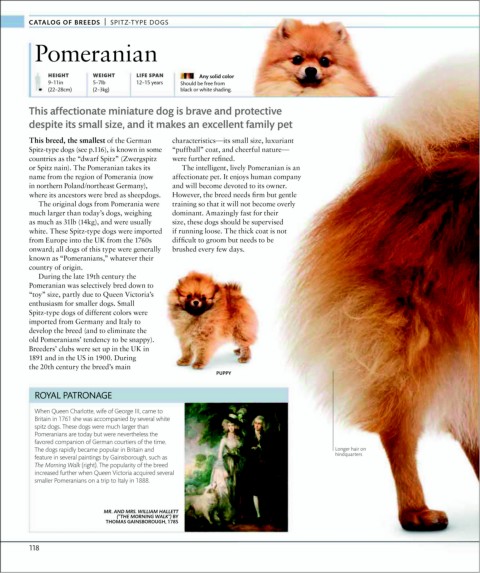
           Pomeranian


               HEIGHT        WEIGHT       LIFE SPAN         Any solid color
               9–11in        5–7lb        12–15 years  Should be free from
               (22–28cm)     (2–3kg)                   black or white shading.


          This affectionate miniature dog is brave and protective
          despite its small size, and it makes an excellent family pet


          This breed, the smallest of the German    characteristics—its small size, luxuriant
          Spitz-type dogs (see p.116), is known in some   “puffball” coat, and cheerful nature—
          countries as the “dwarf Spitz” (Zwergspitz   were further refined.
          or Spitz nain). The Pomeranian takes its      The intelligent, lively Pomeranian is an
          name from the region of Pomerania (now    affectionate pet. It enjoys human company
          in northern Poland/northeast Germany),    and will become devoted to its owner.
          where its ancestors were bred as sheepdogs.   However, the breed needs firm but gentle
             The original dogs from Pomerania were   training so that it will not become overly
          much larger than today’s dogs, weighing    dominant. Amazingly fast for their
          as much as 31lb (14kg), and were usually   size, these dogs should be supervised
          white. These Spitz-type dogs were imported   if running loose. The thick coat is not
          from Europe into the UK from the 1760s    difficult to groom but needs to be
          onward; all dogs of this type were generally   brushed every few days.
          known as “Pomeranians,” whatever their
          country of origin.
             During the late 19th century the
          Pomeranian was selectively bred down to
          “toy” size, partly due to Queen Victoria’s
          enthusiasm for smaller dogs. Small
          Spitz-type dogs of different colors were
          imported from Germany and Italy to
          develop the breed (and to eliminate the
          old Pomeranians’ tendency to be snappy).
          Breeders’ clubs were set up in the UK in
          1891 and in the US in 1900. During
          the 20th century the breed’s main
                                                                 PUPPY


           ROYAL PATRONAGE

           When Queen Charlotte, wife of George III, came to
           Britain in 1761 she was accompanied by several white
           spitz dogs. These dogs were much larger than
           Pomeranians are today but were nevertheless the
           favored companion of German courtiers of the time.
           The dogs rapidly became popular in Britain and                                            Longer hair on
                                                                                                     hindquarters
           feature in several paintings by Gainsborough, such as
           The Morning Walk (right). The popularity of the breed
           increased further when Queen Victoria acquired several
           smaller Pomeranians on a trip to Italy in 1888.


                                MR. AND MRS. WILLIAM HALLETT
                                    (“THE MORNING WALK”) BY
                                THOMAS GAINSBOROUGH, 1785


          118

