


Page 332 - (DK) The Dog Encyclopedia
P. 332
CARE AND TRAINING  |  BEHAVIORAL PROBLEMS


          Behavioral problems


          Most dogs that are trained in basic rules from a young age happily integrate
          into their household. However, some dogs may develop unwanted behaviors
          that require further training or specialized help.


          DESTRUCTIVE BEHAVIOR                      The first stage of training is to put the
          Chewing is a natural behavior in puppies   desired behavior on cue, by associating a
          and dogs, but when it becomes excessive or   command word with the behavior. For
          is targeted toward something inappropriate   example, a dog that chews furniture can be
          it can quickly become a source of tension   taught to chew special toys containing food
          between owner and dog. Sometimes          instead. Offer your dog a toy with treats
          dogs exhibit destructive behavior as an   hidden inside and praise him as he begins to
          outlet because they are experiencing      investigate it, telling him “good boy, chew”
          physical pain or suffer from separation   in a clear voice. It is vital that you make some
          anxiety—a condition characterized by      temporary changes to restrict your dog’s
          extreme distress during the absence of their   opportunities to perform the unwanted
          owner. Dogs can be affected by anxiety    behavior, such as preventing chewing by
          disorders, however supportive and happy   using a bitter spray to make the furniture
          their homelife. You should seek your vet’s   taste unpleasant.
          advice or consult a professional behaviorist if   When you have made a good association
          your dog suffers from anxiety.            between the cue word and the correct
           Occasionally, destructive behavior such    behavior, you have a channel of
          as chewing or digging can become a problem    communication when your dog misbehaves.
          in otherwise healthy, adult dogs. This is often  Do not punish your dog, since he is not
          a sign that the dog is not being sufficiently   being bad—he is displaying a natural
          stimulated, and it may help to provide him   behavior. If you catch him chewing the
          with an acceptable outlet for this natural   furniture, simply interrupt him (for
          behavior—such as allowing him to dig for   example, with a hand clap) and hand him
          treats in a sandpit. This will only work in   his chew toy, saying “good boy, chew.”
          dogs where all of their other needs, such as
          physical exercise, nutritional requirements,   EXCESSIVE BARKING
          and social interaction, are met.          Barking is a completely normal dog
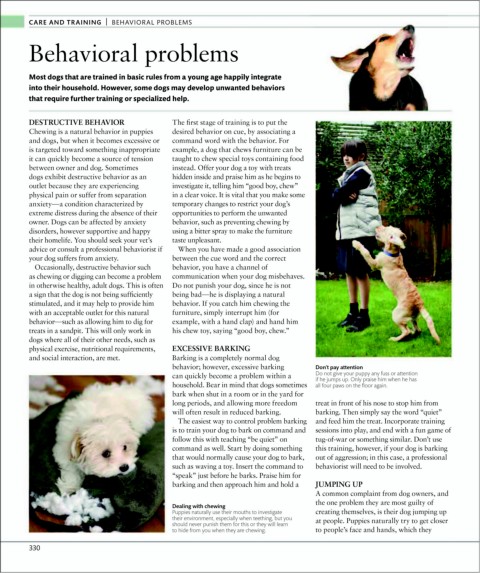
                                                    behavior; however, excessive barking       Don’t pay attention
                                                    can quickly become a problem within a      Do not give your puppy any fuss or attention
                                                                                               if he jumps up. Only praise him when he has
                                                    household. Bear in mind that dogs sometimes   all four paws on the floor again.
                                                    bark when shut in a room or in the yard for
                                                    long periods, and allowing more freedom    treat in front of his nose to stop him from
                                                    will often result in reduced barking.      barking. Then simply say the word “quiet”
                                                      The easiest way to control problem barking  and feed him the treat. Incorporate training
                                                    is to train your dog to bark on command and   sessions into play, and end with a fun game of
                                                    follow this with teaching “be quiet” on    tug-of-war or something similar. Don’t use
                                                    command as well. Start by doing something   this training, however, if your dog is barking
                                                    that would normally cause your dog to bark,   out of aggression; in this case, a professional
                                                    such as waving a toy. Insert the command to   behaviorist will need to be involved.
                                                    “speak” just before he barks. Praise him for
                                                    barking and then approach him and hold a   JUMPING UP
                                                                                               A common complaint from dog owners, and
                                                                                               the one problem they are most guilty of
                                                    Dealing with chewing
                                                    Puppies naturally use their mouths to investigate    creating themselves, is their dog jumping up
                                                    their environment, especially when teething, but you   at people. Puppies naturally try to get closer
                                                    should never punish them for this or they will learn
                                                    to hide from you when they are chewing.    to people’s face and hands, which they


          330

