


Page 72 - Shark
P. 72
Glossary                                                                         Dogfish embryo


          AdAptAtion  Evolutionary biological   ClAspers  Reproductive organs on the   dorsAl fin  One of
          process that enables a species to adjust to    inner edge of a male shark’s pelvic fins,   the fins located on the
          its environment.                     through which sperm is released.    midline of a fish’s back to
                                                                                   stop it from rolling from
          AmpullAe of lorenzini  Sensory       CloACA  Reproductive and excretory   side to side.
          pores on a shark’s snout connected to    opening in the body of a fish.
          delicate, jelly-filled internal canals; they are                         eChinoderm  One
          able to detect electric pulses from potential   CommensAl  Relating to a connection   of a group of marine
          prey as it passes through the water.    between two organisms in which one benefits   invertebrates that
          Scientists believe the ampullae of Lorenzini   and the other is neither helped nor harmed.   provide food for some
          may also be involved in migration, acting as    Pilot fish and sharks, for example, have a   types of shark.
          a kind of natural compass.           commensal relationship: pilot fish gain
                                               protection by swimming underneath sharks,   eCology  The study
          AnAl fin  One of the fins located on the   which are not affected by this in any way.  of how organisms relate
          underside of the body in some sharks.                                    to each other and their
                                               Copepod  One of more than 4,500 species   environment. Experts who
                                               of tiny aquatic animals that are a major   specialize in this field are
                                               component of plankton. Some of these attach   called ecologists.
                                               themselves to sharks’ fins and gills, feeding
                               Barbel          off skin secretions and blood.      eCosystem  Collection
                                                                                   of interacting organisms
                                               CorneA  Tough but transparent membrane   within a particular habitat.
                                               that covers the iris and pupil in the eyes of
                                               vertebrates, octopuses, and squids.  enAmel  Outer coating of
                                                                                   teeth. Enamel is the hardest
                                               CrustACeA  One of a group of hard-  substance in an animal’s body.
                                               shelled aquatic creatures such as crab and
                                               shrimp that provide food for some    emBryo  Developing animal
                                               types of shark.                     before it is born or hatched
                                                                                   from an egg.
                                               dentine  Dense material made from
                                               minerals that forms the principal component   feeding frenzy  The
                           Nurse shark         of teeth.                           uncontrolled behavior of a
                                                                                   group of sharks when there
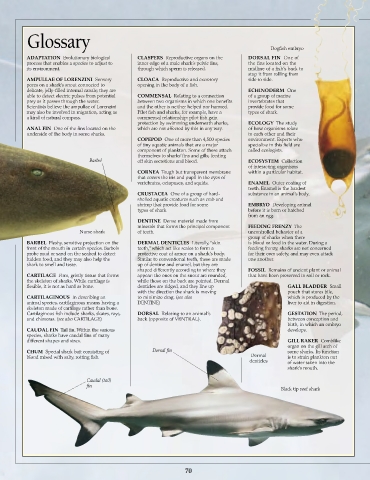
          BArBel  Fleshy, sensitive projection on the   dermAl dentiCles  Literally, “skin   is blood or food in the water. During a
          front of the mouth in certain species. Barbels   teeth,” which act like scales to form a   feeding frenzy, sharks are not concerned
          probe mud or sand on the seabed to detect   protective coat of armor on a shark’s body.   for their own safety, and may even attack
          hidden food, and they may also help the    Similar to conventional teeth, these are made   one another.
          shark to smell and taste.            up of dentine and enamel, but they are
                                               shaped differently according to where they   fossil  Remains of ancient plant or animal
          CArtilAge  Firm, gristly tissue that forms   appear: the ones on the snout are rounded,   that have been preserved in soil or rock.
          the skeleton of sharks. While cartilage is   while those on the back are pointed. Dermal
          flexible, it is not as hard as bone.  denticles are ridged, and they line up          gAll BlAdder  Small
                                               with the direction the shark is moving           pouch that stores bile,
          CArtilAginous  In describing an      to minimize drag. (see also                      which is produced by the
          animal species, cartilaginous means having a   DENTINE)                               liver to aid in digestion.
          skeleton made of cartilage rather than bone.
          Cartilaginous fish include sharks, skates, rays,   dorsAl  Relating to an animal’s    gestAtion  The period,
          and chimeras. (see also CARTILAGE)   back (opposite of VENTRAL).                      between conception and
                                                                                                birth, in which an embryo
          CAudAl fin  Tail fin. Within the various                                              develops.
          species, sharks have caudal fins of many
          different shapes and sizes.                                                           gill rAker  Comblike
                                                                                                organ on the gill arch of
          Chum  Special shark bait consisting of    Dorsal fin                                  some sharks. Its function
          blood mixed with salty, rotting fish.                                     Dermal      is to strain plankton out
                                                                                    denticles   of water taken into the
                                                                                                shark’s mouth.
                              Caudal (tail)
                              fin
                                                                                              Black tip reef shark


                                                              70

