


Page 73 - Shark
P. 73
gills  Breathing organs of fish through   oviduCt  Egg tube of a female shark into
        which oxygen is taken in and carbon dioxide    which sperm is introduced by the male.
        is expelled. In sharks and closely related
        species, the gills appear as a series of    ovipArous  Producing eggs that hatch
        between five and seven slits behind the head.  outside the mother’s body.

                                             ovovivipArous  Producing eggs that
                                             hatch inside the mother’s body.
                                             pArAsite  Animal or plant that lives on
                                             another organism and draws nutrients
                                             from it.

                                             peCtorAl fin  One of a pair of fins
                                             located on the underside of the front
                                             section of a fish’s body. Pectoral fins
                                             provide lift, assist steering, and act as
                                             brakes when necessary.                            Tagging
                  Nurse-shark gills
                                                                                 spirACle  Additional, rounded gill
                                                                                 opening on top of the head in some
                                                                                 bottom-dwelling sharks.
        inverteBrAte  Animal without a
        backbone or spinal column (opposite of   Pectoral fin                          spirAl vAlve  Shark’s efficient,
        VERTEBRATE).                                                                   corkscrew-shaped intestine.
                                               Horn shark
        lAmellAe  Microscopic, capillary-filled                                              tAgging  Method of
        branches that make up the feathery                                                   tracking and studying
        filaments lying across a fish’s gill arches.                                         sharks in the wild by
        These structures absorb oxygen and                                                   attaching tags to their fins
        expel carbon dioxide.                                                                so their movements can
                                                                                             be recorded.
                                                                                 tApetum  Layer of cells lying behind the
                                                                                 retina in the eyes of some fish and nocturnal
                                                                                 animals. These cells reflect light, helping the
                                                                                 creature to see in the dark.

                                                                                 ventrAl  Relating to the underside of the
                                             pelviC fin  One of a pair of fins   body (opposite of DORSAL).
                                             located on the underside of the rear
                                             section of a fish’s body. Smaller than    verteBrAte  Animal that has a
        lAterAl line  Row of pressure-sensitive   pectoral fins, pelvic fins also assist steering    backbone or spinal column (opposite of
        organs that run along each side of a shark’s   and act as stabilizers.   INVERTEBRATE).
        body and around its head. These organs
        can alert the shark to the movement and    plAnkton  Microscopic, sometimes   vertiCAl migrAtion  Movement of
        the proximity of objects in the water by   moving, organisms that provide food for    marine creatures from deep to shallow
        detecting tiny changes in pressure—a great   some shark species. Whale sharks, for    water or vice versa. Planktonic organisms
        advantage when the sea is dark or murky.  example, live mostly on plankton.  migrate in this way daily, and they are
                                                                                 often followed by fish, whales, and other,
        migrAtion  Regular movement of an    predAtor  A creature whose natural   similar, predators.
        animal population from one area to another   inclination is to prey on other animals.
        and back again, often on a yearly basis.                                 vivipArous  Producing young that
                                             shAgreen  Dried shark skin used like   remain in the mother’s body until they are
        niCtitAting memBrAne  Third, inner   sandpaper to polish wood and stone.  fully formed and ready to be born.
        eyelid that moves across the surface of a
        shark’s eye to clean and protect it. This
        function is similar to that of human eyelids
        when we blink.
        olfACtory  Relating to a creature’s
        sense of smell.
        oophAgy  A form of prenatal cannibalism
        in which some developing sharks feed on
        eggs produced by the mother.
        omnivorous  Feeding on all types
        of food, both plant and animal.

        operCulum  Gill cover present in bony
        fish but not in sharks.
        otoliths  Calcium carbonate granules in
        a shark’s ear that allow it to establish its
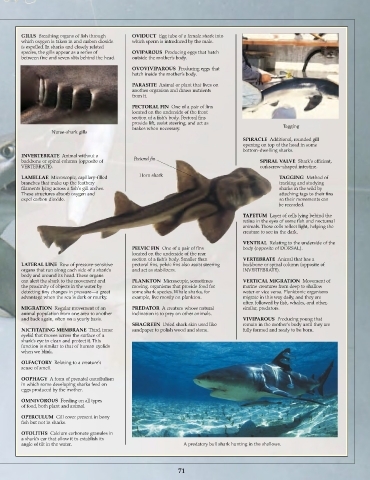
        angle of tilt in the water.                           A predatory bull shark hunting in the shallows.


                                                            71

