


Page 9 - Shark
P. 9
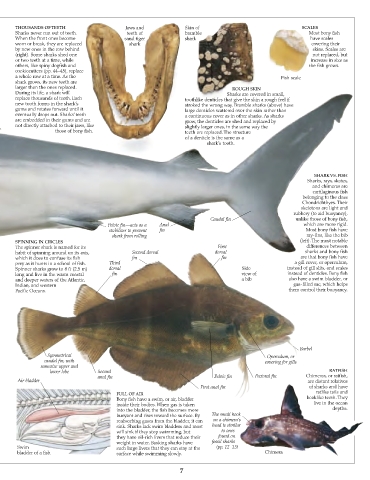
thouSandS oF teeth                   Jaws and           Skin of                                ScaleS
      Sharks never run out of teeth.       teeth of           bramble                                  Most bony fish
      When the front ones become          sand tiger          shark                                     have scales
      worn or break, they are replaced      shark                                                       covering their
      by new ones in the row behind                                                                      skins. Scales are
      (right). Some sharks shed one                                                                      not replaced, but
      or two teeth at a time, while                                                                     increase in size as
      others, like spiny dogfish and                                                                   the fish grows.
      cookiecutters (pp. 44–45), replace
      a whole row at a time. As the                                                           Fish scale
      shark grows, its new teeth are
      larger than the ones replaced.                                          rough Skin
      During its life, a shark will                                         Sharks are covered in small,
      replace thousands of teeth. Each                        toothlike denticles that give the skin a rough feel if
      new tooth forms in the shark’s                          stroked the wrong way. Bramble sharks (above) have
      gums and rotates forward until it                       large denticles scattered over the skin rather than
      eventually drops out. Sharks’ teeth                     a continuous cover as in other sharks. As sharks
      are embedded in their gums and are                      grow, the denticles are shed and replaced by
      not directly attached to their jaws, like               slightly larger ones, in the same way the
                   those of bony fish.                        teeth are replaced. The structure
                                                              of a denticle is the same as a
                                                                      shark’s tooth.


                                                                                                         Shark vS. FiSh
                                                                                                       Sharks, rays, skates,
                                                                                                        and chimeras are
                                                                                                         cartilaginous fish
                                                                                                     belonging to the class
                                                                                                     Chondrichthyes. Their
                                                                                                     skeletons are light and
                                                                                                  rubbery (to aid buoyancy),
                                                                       Caudal fin                  unlike those of bony fish,
                                     Pelvic fin—acts as a   Anal                                     which are more rigid.
                                     stabilizer to prevent   fin                                      Most bony fish have
                                      shark from rolling                                              ray-fins, like the bib
      Spinning in circleS                                                                           (left). The most notable
      The spinner shark is named for its                                 First                        differences between
      habit of spinning around on its axis,   Second dorsal             dorsal                        sharks and bony fish
      which it does to confuse its fish      fin                          fin                        are that bony fish have
      prey as it hunts in a school of fish.   Third                                                a gill cover, or operculum,
      Spinner sharks grow to 8 ft (2.5 m)   dorsal                               Side           instead of gill slits, and scales
      long and live in the warm coastal   fin                                    view of        instead of denticles. Bony fish
      and deeper waters of the Atlantic,                                         a bib           also have a swim bladder, or
      Indian, and western                                                                         gas-filled sac, which helps
      Pacific Oceans.                                                                            them control their buoyancy.


                                                                                                    Barbel
                 Symmetrical                                                             Operculum, or
                caudal fin, with                                                         covering for gills
               samesize upper and
                  lower lobe     Second                                                                       ratFiSh
                                 anal fin                               Pelvic fin   Pectoral fin     Chimeras, or ratfish,
       Air bladder                                                                                     are distant relatives
                                                                   First anal fin                      of sharks and have
                                        Full oF air                                                       ratlike tails and
                                        Bony fish have a swim, or air, bladder                         beaklike teeth. They
                                        inside their bodies. When gas is taken                           live in the ocean
                                        into the bladder, the fish becomes more                                depths.
                                        buoyant and rises toward the surface. By   The small hook
                                        reabsorbing gases from the bladder, it can   on a chimera’s
                                        sink. Sharks lack swim bladders and most   head is similar
                                        will sink if they stop swimming, but   to ones
                                        they have oil-rich livers that reduce their   found on
                                        weight in water. Basking sharks have   fossil sharks
       Swim                             such large livers that they can stay at the   (pp. 12–13)
       bladder of a fish                surface while swimming slowly.                   Chimera

