


Page 14 - Shark
P. 14
A megalodon’s                Serrated edge
        tooth (actual                for cutting                Ancient sharks
        size)


                                                                The first sharks appeared in the ancient
                                                                seas 400 million years ago, about 200 million
                                                                years before dinosaurs roamed the Earth.
                                                                At that time there were no reptiles, birds, or
                                               Actual size      mammals. The remains of some of these early
                                             tooth of a great
                                               white shark      sharks were fossilized when they fell to the
                                               (pp. 28–31)      bottom of the sea and became covered with
                                                                layers of sand and other sediment. Hard parts,
                                                     Flat, ridged   like spines and teeth, fossilized more easily than
                                                     side for
                                                     crushing   soft parts, which often rotted away. Sometimes
                                                     prey       all that is left are impressions of the sharks
                                                                    in rocks. Fossil shark teeth are common
                                                                      because these ancient sharks, like their
                                                                       living descendants, shed many teeth in
                                                                        a lifetime. Sharks’ rubbery skeletons,
                                                                        made of cartilage, did not preserve as
                                                            Tooth of    well as the hard skeletons of bony fish.
                                                           Ptychodus   Shark fossils are often
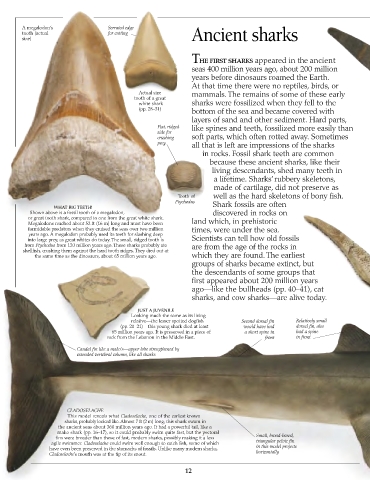
                   What big teeth!
           Shown above is a fossil tooth of a megalodon,               discovered in rocks on
          or great tooth shark, compared to one from the great white shark.   land which, in prehistoric
          Megalodons reached about 52 ft (16 m) long and must have been
          formidable predators when they cruised the seas over two million   times, were under the sea.
          years ago. A megalodon probably used its teeth for slashing deep
          into large prey, as great whites do today. The small, ridged tooth is   Scientists can tell how old fossils
         from Ptychodus from 120 million years ago. These sharks probably ate   are from the age of the rocks in
         shellfish, crushing them against the hard tooth ridges. They died out at
             the same time as the dinosaurs, about 65 million years ago.  which they are found. The earliest
                                                                groups of sharks became extinct, but
                                                                the descendants of some groups that
                                                                first appeared about 200 million years
                                                                ago—like the bullheads (pp. 40–41), cat
                                                                sharks, and cow sharks—are alive today.


                                               Just a Juvenile
                                            Looking much the same as its living
                                            relative—the lesser spotted dogfish   Second dorsal fin   Relatively small
                                         (pp. 20–21)—this young shark died at least   would have had   dorsal fin, also
                                      65 million years ago. It is preserved in a piece of   a short spine in   had a spine
                                    rock from the Lebanon in the Middle East.            front     in front

                           Caudal fin like a mako’s—upper lobe strengthened by
                           extended vertebral column, like all sharks


                       CladoSelaChe
                       This model reveals what Cladoselache, one of the earliest known
                      sharks, probably looked like. Almost 7 ft (2 m) long, this shark swam in
                    the ancient seas about 360 million years ago. It had a powerful tail, like a
                    mako shark (pp. 16–17), so it could probably swim quite fast, but the pectoral
                   fins were broader than those of fast, modern sharks, possibly making it a less   Small, broad-based,
                  agile swimmer. Cladoselache could swim well enough to catch fish, some of which   triangular pelvic fin
                 have even been preserved in the stomachs of fossils. Unlike many modern sharks,   in this model projects
                 Cladoselache’s mouth was at the tip of its snout.                    horizontally

                                                              12

