


Page 12 - Shark
P. 12
Inside a shark


                                                                               Danger below
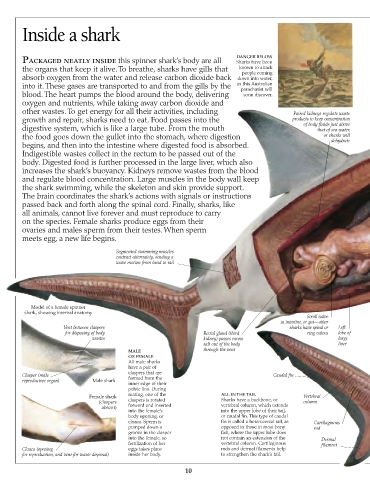
        packaged neatly inside this spinner shark’s body are all               Sharks have been
        the organs that keep it alive. To breathe, sharks have gills that       known to attack
                                                                                 people coming
        absorb oxygen from the water and release carbon dioxide back  down into water,
        into it. These gases are transported to and from the gills by the      as this Australian
                                                                                 parachutist will
        blood. The heart pumps the blood around the body, delivering              soon discover.
        oxygen and nutrients, while taking away carbon dioxide and
        other wastes. To get energy for all their activities, including                           Paired kidneys regulate waste
        growth and repair, sharks need to eat. Food passes into the                               products to keep concentration
        digestive system, which is like a large tube. From the mouth                                  of body fluids just above
                                                                                                          that of sea water,
        the food goes down the gullet into the stomach, where digestion                                     or sharks will
        begins, and then into the intestine where digested food is absorbed.                                   dehydrate
        Indigestible wastes collect in the rectum to be passed out of the
        body. Digested food is further processed in the large liver, which also
        increases the shark’s buoyancy. Kidneys remove wastes from the blood
        and regulate blood concentration. Large muscles in the body wall keep
        the shark swimming, while the skeleton and skin provide support.
        The brain coordinates the shark’s actions with signals or instructions
        passed back and forth along the spinal cord. Finally, sharks, like
        all animals, cannot live forever and must reproduce to carry
        on the species. Female sharks produce eggs from their
        ovaries and males sperm from their testes. When sperm
        meets egg, a new life begins.

                                       Segmented swimming muscles
                                       contract alternately, sending a
                                       wave motion from head to tail


           Model of a female spinner
         shark, showing internal anatomy
                                                                                                       Scroll valve
                                                                                              in intestine, or gut—other
                      Vent between claspers                                                      sharks have spiral or   Left
                       for disposing of body                        Rectal gland (third                ring valves  lobe of
                                wastes                              kidney) passes excess                        large
                                                                    salt out of the body                         liver
                                            Male                    through the vent
                                            or feMale
                                            All male sharks
                                            have a pair of
                                            claspers that are
        Clasper (male                       formed from the                                Caudal fin
        reproductive organ)     Male shark
                                            inner edge of their
                                            pelvic fins. During
                               Female shark   mating, one of the          all in the tail            Vertebral
                                  (claspers   claspers is rotated         Sharks have a backbone, or   column
                                   absent)  forward and inserted          vertebral column, which extends
                                            into the female’s             into the upper lobe of their tail,
                                            body opening, or              or caudal fin. This type of caudal
                                            cloaca. Sperm is              fin is called a heterocercal tail, as   Cartilaginous
                                            pumped down a                 opposed to those in most bony   rod
                                            groove in the clasper         fish, where the upper lobe does
                                            into the female, so           not contain an extension of the   Dermal
                                            fertilization of her          vertebral column. Cartilaginous   filament
        Cloaca (opening                     eggs takes place              rods and dermal filaments help
        for reproduction, and vent for waste disposal)  inside her body.  to strengthen the shark’s tail.

                                                              10

