


Page 244 - Portuguese Dictionary Phrasebook (The Rough Guide)
P. 244
Nouns
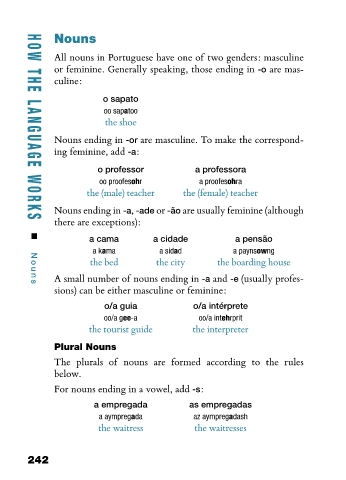
                 All nouns in Portuguese have one of two genders: masculine
                 or feminine. Generally speaking, those ending in -o are mas-
                 culine:
                         o sapato
                          oo sapatoo
                          the shoe
                 Nouns ending in -or are masculine. To make the correspondr  -
                 ing feminine, add -a:
                         o professor     a professora
                         oo proofesohr    a proofesohra
                       the (male) teacher  the (female) teacher
                 Nouns ending in -a, -ade or -ão are usually feminine (although
                 there are exceptions):
             HOW THE LANGUAGE WORKS
                       a cama     a cidade      a pensão
             N
                        a kama     a sidad      a paynsowng
                       the bed    the city   the boarding house
                 A small number of nouns ending in -a and -e (usually profes-
             Nouns
                 sions) can be either masculine or feminine:
                          o/a guia       o/a intérprete
                          oo/a gee-a      oo/a intehrprit
                       the tourist guide  the interpreter
                 Plural Nouns
                 The  plurals of nouns are formed according to the rules
                 below.
                 For nouns ending in a vowel, add -s:
                        a empregada     as empregadas
                         a aympregada    az aympregadash
                         the waitress    the waitresses

             242


 RG New PORTUGUESE How the Langua242   24242  24242

