


Page 265 - (DK Eyewitness) Travel Guide - South Africa
P. 265
INTRODUCING THE EAST C O AST AND INTERIOR 263
Traditional Dancing
In Zulu society, social gatherings almost always
involve dancing. Most Zulu dances require a high
level of fitness – and a lack of inhibition. While
ceremonial dances can involve large crowds of
gyrating, clapping and stamping performers,
small groups of performers need only the
encouragement of an accompanying drum and
singing, whistling or wailing onlookers. Lore and
clan traditions may be related through the dance;
alternatively, the movements may serve as a
Zulu dances require stamina and agility means of social commentary.
Water is always carried
on the head, sometimes Grain Storage
over long distances. To protect their
grain from birds
and rodents, the
Zulu stored maize
and sorghum in a
hut on long stilts.
Clay pots, for water, grain or
sorghum beer, are smoothed and
decorated before firing.
The Zulu Kraal
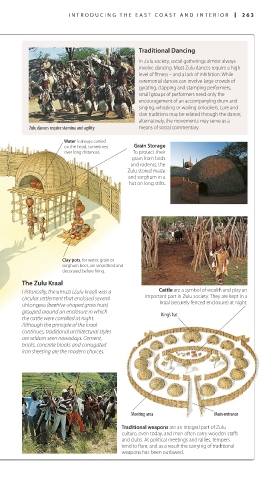
Historically, the umuzi (Zulu kraal) was a Cattle are a symbol of wealth and play an
circular settlement that enclosed sev eral important part in Zulu society. They are kept in a
uhlongwa (beehive-shaped grass huts) kraal (securely fenced enclosure) at night.
grouped around an enclosure in which King’s hut
the cattle were corralled at night.
Although the principle of the kraal
continues, traditional architectural styles
are seldom seen nowadays. Cement,
bricks, concrete blocks and corrugated
iron sheeting are the modern choices.
Meeting area Main entrance
Traditional weapons are an integral part of Zulu
culture, even today, and men often carry wooden staffs
and clubs. At political meetings and rallies, tempers
tend to flare, and as a result the carrying of traditional
weapons has been outlawed.
262-263_EW_South_Africa.indd 263 25/05/17 2:47 pm

