


Page 264 - (DK Eyewitness) Travel Guide - South Africa
P. 264
262 THE EAST C O AST AND INTERIOR
Zulu Culture
The Zulu people’s reputation for being a fierce warrior
nation, fuelled by written accounts of the 1879 Anglo-Zulu Johannesburg
War, has been enhanced by dramatic films such as Zulu, and
the internationally acclaimed television series Shaka Zulu. Durban
Many sites associated with Zulu history can be visited in the Cape Town
Ulundi, Eshowe and Melmoth districts of KwaZulu-Natal. It
is true that the Zulu fought determinedly to defend their Locator Map
land, but their culture also reflects other, gentler, aspects in KwaZulu-Natal
bead work, pottery, basketry and dancing. In the remote
Tugela River Valley and the northern parts of the province,
rural people uphold many old customs.
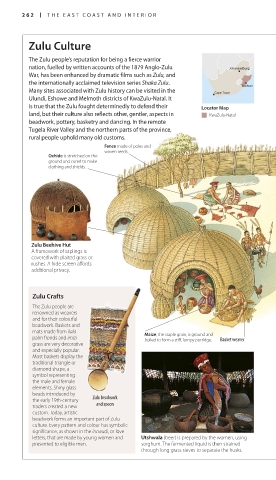
Fence made of poles and
woven reeds.
Oxhide is stretched on the
ground and cured to make
clothing and shields.
Zulu Beehive Hut
A framework of saplings is
covered with plaited grass or
rushes. A hide screen affords
additional privacy.
Zulu Crafts
The Zulu people are
renowned as weavers
and for their colourful
beadwork. Baskets and
mats made from ilala Maize, the staple grain, is ground and
palm fronds and imizi boiled to form a stiff, lumpy porridge. Basket weaver
grass are very decorative
and espe cially popular.
Most baskets display the
traditional triangle or
diamond shape, a
symbol represent ing
the male and female
elements. Shiny glass
beads introduced by Zulu beadwork
the early 19th-century
traders created a new and spoon
custom. Today, artistic
beadwork forms an important part of Zulu
culture. Every pattern and colour has symbolic
signific ance, as shown in the incwadi, or love
letters, that are made by young women and Utshwala (beer) is prepared by the women, using
presented to eligible men. sorghum. The fermented liquid is then strained
through long grass sieves to separate the husks.
262-263_EW_South_Africa.indd 262 25/05/17 2:47 pm

