


Page 266 - (DK Eyewitness) Travel Guide - South Africa
P. 266
264 THE EAST C O AST AND INTERIOR
Durban’s Surfing Scene
The invention of fibreglass surfboards in the 1960s
caused a surge in devotees of the sport. Durban, with
its warm currents, consistent waves and perfect beaches,
quickly became the country’s surfing capital. Popular
and consistent sites capable of holding sizeable winter
and summer swell are the Bay of Plenty, New Pier, North
Beach, Wedge, Dairy and – for more experienced surfers –
Cave Rock Bluff. In recent decades, Jeffreys Bay (see Jordy Smith, who began surfing
p247), in the Eastern Cape, has emerged as a rival in Durban aged six, competes
to Durban as South Africa’s top 10 surfer hang-out, professionally in the World Surf
League (WSL). In 2014 he won the
thanks to the 1 km- (half a mile-) long ride offered by Hurley Pro in southern California.
the Supertubes break.
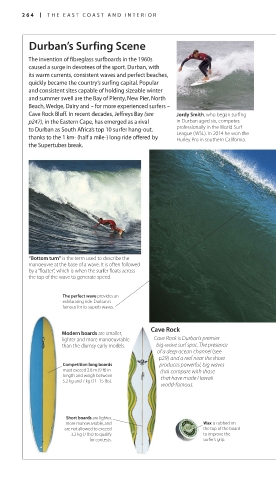
“Bottom turn” is the term used to describe the
manoeuvre at the base of a wave. It is often followed
by a “floater”, which is when the surfer floats across
the top of the wave to generate speed.
The perfect wave provides an
exhilarating ride. Durban is
famous for its superb waves.
Cave Rock
Modern boards are smaller,
lighter and more manoeuvrable Cave Rock is Durban’s premier
than the clumsy early models. big-wave surf spot. The presence
of a deep ocean channel (see
p29) and a reef near the shore
Competition long boards produces powerful, big waves
must exceed 2.8 m (9 ft) in that compare with those
length and weigh between
5.2 kg and 7 kg (11–15 lbs). that have made Hawaii
world-famous.
Short boards are lighter,
more manoeuvrable, and Wax is rubbed on
are not allowed to exceed the top of the board
3.2 kg (7 lbs) to qualify to improve the
for contests. surfer’s grip.
264-265_EW_South_Africa.indd 264 25/05/17 11:59 am

