


Page 346 - (DK Eyewitness) Travel Guide - South Africa
P. 346
344 GA UTENG , LIMPOPO AND MPUM ALANGA
Exploring Northern Kruger
An immense wilderness of semi-arid Mopani woodland
bisected by a few sandy seasonal rivers, northern Kruger sees
very few tourists compared with the south. The long drive
from Gauteng is one reason for the north’s obscurity, but
there are also far fewer tourist amenities north of the Olifants
River, and game-viewing tends to be more challenging.
Despite this, many experienced safari-goers are besotted with
northern Kruger, returning time and time again to absorb its
untrammelled bush atmosphere. Few organized safaris head
to northern Kruger, but a good network of surfaced roads
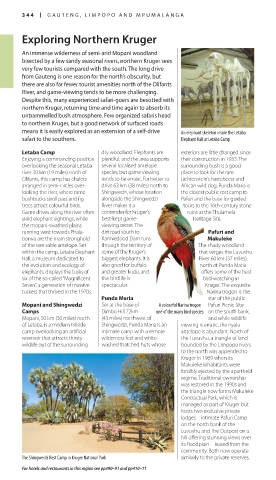
means it is easily explored as an extension of a self-drive An elephant skeleton inside the Letaba
safari to the southern. Elephant Hall at Letaba Camp
Letaba Camp dry woodland. Elephants are exteriors are little changed since
Enjoying a commanding position plentiful, and the area supports their construction in 1933. The
overlooking the seasonal Letaba several localised antelope surrounding bush is a good
river 30 km (19 miles) north of species, but game viewing place to look for the rare
Olifants, this camp has chalets tends to be erratic. Far better to Lichtenstein’s hartebeest and
arranged in semi-circles over- drive 63 km (38 miles) north to African wild dog. Punda Maria is
looking the river, where tame Shingwedzi, whose location the closest public rest camp to
bushbucks stroll past and fig alongside the Shingwedzi Pafuri and the base for guided
trees attract colourful birds. River makes it a tours to the 16th-century stone
Game drives along the river often contender for Kruger’s ruins at the Thulamela
yield elephant sightings, while best-kept game- Heritage Site.
the mopani-swathed plains viewing secret. The
running west towards Phala- dirt road south to Pafuri and
borwa are the main stronghold Kanniedood Dam runs Makuleke
of the rare sable antelope. Set through the territory of The shady woodland
within the camp, Letaba Elephant some of the Kruger’s that verges the Luvuvhu
Hall, a museum dedicated to biggest elephants. It is River 60 km (37 miles)
the evolution and ecology of also good for buffalo north of Punda Maria
elephants, displays the tusks of and greater kudu, and offers some of the best
six of the so-called “Magnificent the birdlife is bird-watching in
Seven”, a generation of massive spectacular. Kruger. The exquisite
tuskers that thrived in the 1970s. Narina trogon is the
Punda Maria star of the public
Mopani and Shingwedzi Set at the base of A colourful Narina trogon Pafuri Picnic Site
Camps Dimbo Hill 72km one of the many bird species on the south bank,
Mopani, 50 km (30 miles) north (43 miles) northwest of and while wildlife
of Letaba, is a modern hillside Shingwedzi, Punda Maria is an viewing is erratic, the nyala
camp overlooking an artificial intimate camp with a remote antelope is abundant. North of
reservoir that attracts thirsty wilderness feel and white- the Luvuvhu, a triangle of land
wildlife out of the surrounding washed thatched huts whose bounded by the Limpopo rivers
to the north was appended to
Kruger in 1969 when its
Makuleke inhabitants were
forcibly ejected by the apartheid
regime. Traditional ownership
was restored in the 1990s and
the triangle now forms Makuleke
Contractual Park, which is
managed as part of Kruger but
hosts two exclusive private
lodges – intimate Pafuri Camp
on the north bank of the
Luvuvhu and The Outpost on a
hill offering stunning views over
its floodplain – leased from the
community. Both now operate
The Shingwedzi Rest Camp in Kruger National Park similarly to the private reserves.
For hotels and restaurants in this region see pp390–91 and pp410–11
344-345_EW_South_Africa.indd 344 25/05/17 12:00 pm

