


Page 348 - (DK Eyewitness) Travel Guide - South Africa
P. 348
346 GA UTENG , LIMPOPO AND MPUM ALANGA
e Swaziland
The kingdom of Swaziland achieved its independence from Johannesburg
Britain on 6 September 1968. King Mswati III has ruled the SWAZILAND
almost one million Swazis since 1986. In the west of the
country, the highlands offer many opportuni ties for hikers. Cape Town
The middleveld has the perfect growing conditions for
tropical fruit and is known for its arts and crafts. In the east, Bulembu
lush sugar cane plantations contrast with the dense brown J
bushveld of game reserves and ranches. Piggs
Peak
Hartbeeskop Malolotja Komati
Nature Reserve
Ngwenya
Ngwenya J
Waverley Forbes Reef
Mine
Motjane
MBABANE J
Sandlane HHOHHO
Lusutfu
Mhlambanyatsi
Bhunya Ezulwini Mbuluzi
Mlilwane Wildlife Lobamba
J
Sanctuary Luve
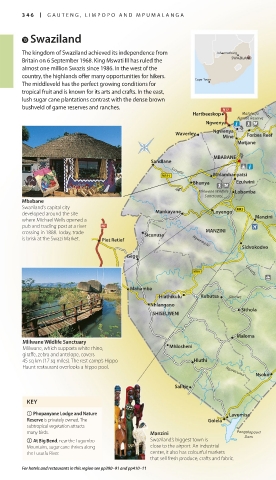
Mbabane
Swaziland’s capital city
developed around the site Mankayane Loyengo Manzini
where Michael Wells opened a Manfutseni
pub and trading post at a river
crossing in 1888. Today, trade Sicunusa MANZINI
is brisk at the Swazi Market. Piet Retief Ngwempisi
Sidvokodvo
Gege
Mkhaya
Nature Reserve
Lusutfu
Siphofaneni
Mahamba
Hlathikulu Kubutsa Sibowe
Nhlangano
Sithola
SHISELWENI
Maloma Big Bend
Mlilwane Wildlife Sanctuary
Mlilwane, which supports white rhino, Mhlosheni
giraffe, zebra and antelope, covers
45 sq km (17 sq miles). The rest camp’s Hippo Hluthi
Haunt restaurant overlooks a hippo pool.
Nsoko
Ngwavuma
Salitje
KEY
1 Phopanyane Lodge and Nature Lavumisa
Reserve is privately owned. The Golela
subtropical vegetation attracts
many birds. Manzini Pongolapoort
2 At Big Bend, near the Lugumbo Swaziland’s biggest town is Dam
Mountains, sugar cane thrives along close to the airport. An industrial
the Lusutfu River. centre, it also has colourful markets
that sell fresh produce, crafts and fabric.
For hotels and restaurants in this region see pp390–91 and pp410–11
346-347_EW_South_Africa.indd 346 25/05/17 2:47 pm

