


Page 24 - Fish and Amphibians (Britannica Illustrated Science Library)
P. 24
20 LIFE IN THE WATER FISH AND AMPHIBIANS 21
Protective Layer Focus
EPIDERMIS
Toothed With protective
ost fish are covered with scales, an external layer spokes mucus
of transparent plates. All fish of a given species have
M the same number of scales. Depending on the family and
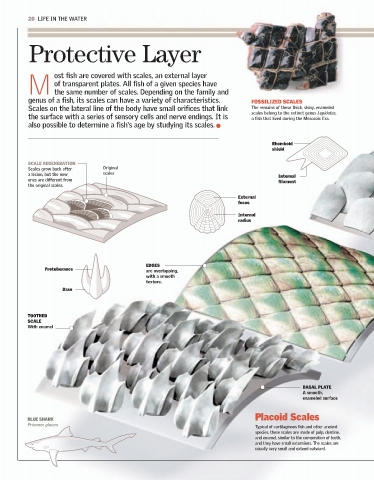
genus of a fish, its scales can have a variety of characteristics. FOSSILIZED SCALES
Scales on the lateral line of the body have small orifices that link The remains of these thick, shiny, enameled
scales belong to the extinct genus Lepidotes, EPIDERMIS
the surface with a series of sensory cells and nerve endings. It is a fish that lived during the Mesozoic Era. covers most of the
also possible to determine a fish's age by studying its scales. body.
Rhomboid
shield
TOOTHED EDGES
provide roughness.
SCALE REGENERATION
Scales grow back after Original
a lesion, but the new scales Internal
ones are different from
filament
the original scales.
Ctenoid scales
External These scales overlap like tiles on a roof,
focus the same as cycloid scales. Another
very common type of scale among
Internal bony fish, they are rough, having small
radius SHIELDS extensions that look like combs.
The sturgeon has PERCH
five rows of these. Perca sp.
Ganoid scales
EDGES Rhomboid in shape, these scales are interwoven
Protuberance are overlapping, and connected with fibers. The name comes from
with a smooth their outer covering, which is a layer of ganoin, a
texture. type of shiny enamel. Sturgeon and pipefish have AGE BY SCALES
scales of this type. A fish does not add new scales as it
Base
grows, but the scales it has increase
in size. In this way growth rings are
CUTICLE formed, and the rings reveal the age
has a mucous of the specimen.
consistency.
TOOTHED
SCALE
With enamel
STURGEON Winter
growth line
Cycloid scales Acipenser sturio
One of the most common types of scales DISTRIBUTION OF SCALES Summer
among bony fish, the cycloid scales are Most scales occur in rows that slant diagonally growth line
organized so that the exposed surfaces downward and back. Species can be accurately
overlap, forming a smooth and flexible cover. identified by the number of rows (as counted
They are round with a soft, exposed surface, along the lateral line), among other Exposed
such as those of carps and silversides. characteristics. area
BASAL PLATE
A smooth, Transverse
enameled surface line Lateral
line
Placoid Scales
BLUE SHARK SALMON
Prionace glauca
Typical of cartilaginous fish and other ancient Family Salmonidae
species, these scales are made of pulp, dentine,
and enamel, similar to the composition of teeth,
RED SNAPPER
and they have small extensions. The scales are
Lutjanus campechanus
usually very small and extend outward.

