


Page 27 - Fish and Amphibians (Britannica Illustrated Science Library)
P. 27
22 LIFE IN THE WATER                                                                    FISH AND AMPHIBIANS 23


 Extremities                                  Dorsal
                                              finΩstabilizing
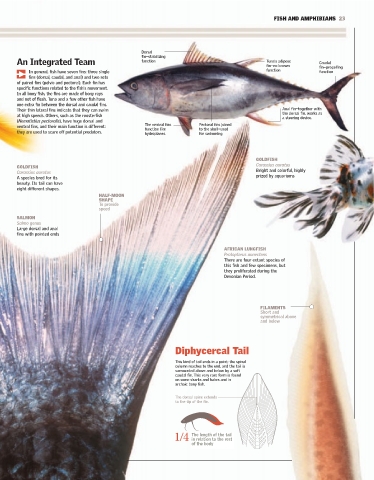
      An Integrated Team
                                              function
                                                                                       Tuna's adipose
                                                                                       finΩno known     Caudal
                                                                                                        finΩpropelling
 fish can control its motion, direction, and stability by means of its   In general, fish have seven fins: three single  function  function
          fins (dorsal, caudal, and anal) and two sets
 fins and tail. Anatomically these are extensions of the skin beyond the  of paired fins (pelvic and pectoral). Each fin has
 A body and, in most bony fish, are supported by rays. The fins reveal  specific functions related to the fish's movement.
      In all bony fish, the fins are made of bony rays
 much about the life of each fish. Thin fins with a split tail indicate that the  and not of flesh. Tuna and a few other fish have
 animal moves very quickly, or it may need them to cover great distances.   one extra fin between the dorsal and caudal fins.
      Their thin lateral fins indicate that they can swim                                   Anal finΩtogether with
 On the other hand, fish that live among rocks and reefs near the ocean   at high speeds. Others, such as the roosterfish  the dorsal fin, works as
                                                                                            a steering device.
 floor have broad lateral fins and large tails.  (Nematistius pectoralis), have huge dorsal and  The ventral fins  Pectoral fins joined
      ventral fins, and their main function is different:  function like  to the skullΩused
      they are used to scare off potential predators.
                                                hydroplanes.     for swimming
                                                                                   GOLDFISH
                                                                                   Carassius auratus
      GOLDFISH
                                                                                   Bright and colorful, highly
      Carassius auratus
                                                                                   prized by aquariums
      A species bred for its
      beauty. Its tail can have
      eight different shapes.
 FIN RAYS
 Bony filaments                  HALF-MOON
 that are joined by              SHAPE
 SIAMESE   a membrane            To provide
 FIGHTING FISH                   speed
 Betta splendens
 spreads its fins like   SALMON
 a fan when it jumps.  Salmo genus
      Large dorsal and anal
      fins with pointed ends
                                                                         AFRICAN LUNGFISH
                                                                         Protopterus annectens
 Homocercal Tail                                                         There are four extant species of
                                                                         this fish and few specimens, but
 The highest                                                             they proliferated during the
 and longest  The caudal fin is divided into two equal lobes,            Devonian Period.
 lobe turns  an upper and a lower lobe, which extend from
 upward.  the end of the spinal column.
 GREY REEF SHARK  The spinal column
 Carcharhinus amblyrhynchos  ends in a broadened                                     FILAMENTS
 structure.
 The heterocercal tail is typical                                                    Short and
 of these cartilaginous fish, as  1/8  The proportion of the length of a salmon's    symmetrical above
 homocercal tail with respect to its body.
 well as of sturgeons.                                                               and below

 The Typical Tail                                        Diphycercal Tail


 Heterocercal Tail  The vast majority of bony fish have homocercal tails.  This kind of tail ends in a point; the spinal
                                                         column reaches to the end, and the tail is
                                                         surrounded above and below by a soft
 Its two lobes are uneven. The dorsal spine turns        caudal fin. This very rare form is found
 upward in the highest lobe, and the rays that           on some sharks and hakes and in
 form the two lobes of the caudal fin extend             archaic bony fish.
 from the lower end of the spinal column.
                                                         The dorsal spine extends
                                                         to the tip of the fin.
 The shark's spine extends into
 the upper lobe of the caudal fin.


 The lower lobe is                                             The length of the tail
 smaller and is merely a                                 1/4 in relation to the rest
 1/3  The proportion of the lower lobe of  projection to the side  of the body
 the tail to the upper lobe of the tail
 of the spine.

