


Page 29 - Fish and Amphibians (Britannica Illustrated Science Library)
P. 29
24 LIFE IN THE WATER                                                                    FISH AND AMPHIBIANS 25


 The Art of Swimming  Forward                  The                                   Upward and

                                               dorsal fin
          Motion                               keeps the                             Downward
                                               fish
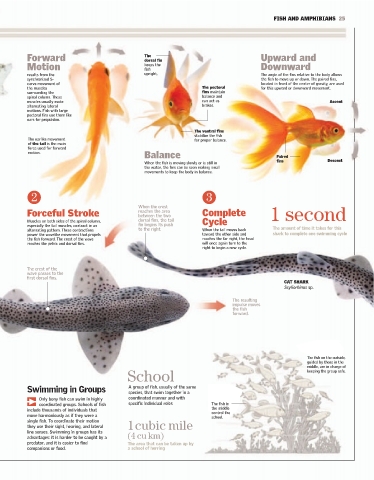
 o swim, fish move in three dimensions: forward and back, left   results from the  upright.  The angle of the fins relative to the body allows
          synchronized S-                                                            the fish to move up or down. The paired fins,
 and right, and up and down. The main control surfaces that fish  curve movement of  located in front of the center of gravity, are used
 T use for maneuvering are the fins, including the tail, or caudal fin. To  the muscles  The pectoral  for this upward or downward movement.
                                                                  fins maintain
          surrounding the
 change direction, the fish tilts the control surfaces at an angle to the water  UPSIDE-DOWN  spinal column. These  balance and  Ascent
                                                                  can act as
          muscles usually make
 current. The fish must also keep its balance in the water; it accomplishes   CATFISH   alternating lateral  brakes.
 Synodontis nigriventris  motions. Fish with large
 this by moving its paired and unpaired fins.  pectoral fins use them like
 This fish swims upside down,   oars for propulsion.
 seeking food sources that are
 less accessible to other species.
                                                               The ventral fins
                                                               stabilize the fish
          The oarlike movement                                 for proper balance.
          of the tail is the main
 MUSCLES  GREAT WHITE SHARK  Red muscles are for slow  force used for forward
 The tail has powerful muscles that  Carcharodon carcharias  or regular movements.  motion.
 enable it to move like an oar.                Balance                                    Paired
                                                                                          fins            Descent
                                               When the fish is moving slowly or is still in
                                               the water, the fins can be seen making small
                                               movements to keep the body in balance.
 Larger white muscles are
 for moving with speed, but
 they tire easily.
 1         2                                                       3
                                             When the crest
                                             reaches the area
 Starting Out   Forceful Stroke              between the two      Complete              1 second
          Muscles on both sides of the spinal column,  dorsal fins, the tail  Cycle
 The movement of a fish through the  The crest of the body's wave  especially the tail muscles, contract in an  fin begins its push
 water is like that of a slithering snake.  moves from back to front.  alternating pattern. These contractions  to the right.  When the tail moves back  The amount of time it takes for this
 Its body goes through a series of  power the wavelike movement that propels  toward the other side and  shark to complete one swimming cycle
 wavelike movements similar to an S  In its side-to-side  the fish forward. The crest of the wave  reaches the far right, the head
 movement, the tail
 curve. This process begins when the  displaces the water.  reaches the pelvic and dorsal fins.  will once again turn to the
 fish moves its head slightly from                                right to begin a new cycle.
 side to side.
          The crest of the
          wave passes to the
          first dorsal fins.
                                                                                            CAT SHARK
                                                                                            Scyliorhinus sp.
                                                                            The resulting
 STREAMLINED SHAPE                                                          impulse moves
 Like the keel of a ship, the rounded contours of a fish                    the fish
 At first the  are instrumental. In addition, most of a fish's volume       forward.
 tail is even  is in the front part of its body. As the fish swims
 with the head.  forward, its shape causes the density of the water  The head
 ahead to be reduced relative to the density of the  moves from
 water behind. This reduces the water's resistance.  side to side.

                                                                                                    The fish on the outside,
                                                                                                    guided by those in the
 THE FISH'S KEEL  THE FASTEST                                                                       middle, are in charge of
 A ship has a heavy keel in the                                                                     keeping the group safe.
 lower part to keep it from  The powerful caudal  The unfurled dorsal  School
 capsizing. Fish, on the other hand,  fin displaces large  fin can be up to 150
 have the keel on top. If the paired  amounts of water.  percent of the width  Swimming in Groups  A group of fish, usually of the same
 fins stop functioning to keep the  SAILFISH  of the fish's body.  species, that swim together in a
 fish balanced, the fish turns over  Istiophorus  Only bony fish can swim in highly  coordinated manner and with
 because its heaviest part tends to  platypterus   coordinated groups. Schools of fish  specific individual roles  The fish in
                                                                     the middle
 sink, which happens when fish die.   include thousands of individuals that  control the
          move harmoniously as if they were a                        school.
          single fish. To coordinate their motion
          they use their sight, hearing, and lateral  1cubic mile
 Its long upper jaw  line senses. Swimming in groups has its
 enables it to slice  advantages: it is harder to be caught by a  (4 cu km)
 KEEL  LIVE  DEAD  70 miles per hour (109 km/h)  through the water,  predator, and it is easier to find  The area that can be taken up by
 aiding this fish's
 FISH  FISH                               a school of herring
 The maximum swimming speed it attains  hydrodynamics.  companions or food.

