


Page 45 - Fish and Amphibians (Britannica Illustrated Science Library)
P. 45
40 DIVERSITY                                                                            FISH AND AMPHIBIANS 41


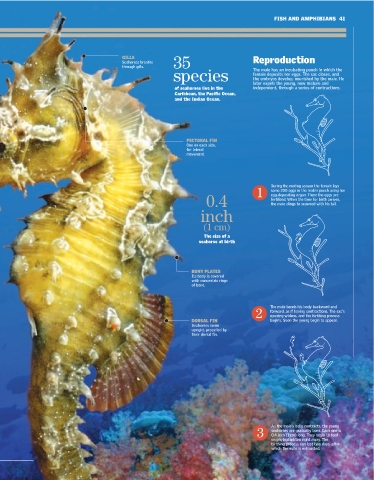
 Long and Flexible                      GILLS                                     Reproduction

                                        Seahorses breathe
                                        through gills.   35                       The male has an incubating pouch in which the
 he seahorse is a small ocean fish that belongs to the same family as pipefish and sea  species  female deposits her eggs. The sac closes, and
                                                                                  the embryos develop, nourished by the male. He
 dragons (Syngnathidae). Its name comes from its horselike head. In fact, no other fish  later expels the young, now mature and
                                                         of seahorses live in the  independent, through a series of contractions.
 T genus has its head at a right angle to the rest of its body. Because it cannot use speed  Caribbean, the Pacific Ocean,
 to escape from its predators, the seahorse has the ability to change color to blend in with its  and the Indian Ocean.
 environment. The reproduction process of these fish is also very unique. The male has an
 incubating pouch in which the female deposits the fertilized eggs.


 BLACK-STRIPED PIPEFISH                                      PECTORAL FIN
 Syngnathus abaster                                          One on each side,
 EYES                                                        for lateral
 One of the slowest fish in the sea, the  Large, for         movement
 acute vision
 black-striped pipefish moves by means
 of slight undulations of its pectoral  Movement
 fins, which can vibrate up to 35
 times per second.  The body of a seahorse is crammed into an
 armor of large, rectangular bony plates.  NOSE
 Pipe-shaped,
 They swim very differently than other fish.  giving the                                During the mating season the female lays
 Adopting an upright position, they use their                                           some 200 eggs in the male's pouch using her
 dorsal fin for propulsion. They do not have  head a                               1    egg-depositing organ. There the eggs are
 an anal fin, but rather a long tail that rolls  horselike         0.4                  fertilized. When the time for birth arrives,
 into a spiral. They use it to hold onto  shape                                         the male clings to seaweed with his tail.
 underwater plants.
 Classification                                                  inch
 HEAD
 Thirty-two species of seahorse have been identified              (1 cm)
 worldwide. Classifying them is at times complicated
 because individuals of the same species can change color          The size of a
 and develop long filaments of skin. The size of adult           seahorse at birth
 seahorses varies enormously, from the tiny Hippocampus
 minotaur—a species discovered in Australia that never  TRUNK
 grows beyond 0.7 inch (1.8 cm) long—to the enormous  The body is
 Hippocampus ingens, a species in the Pacific that reaches  supported
 by the spinal
 over 12 inches (30 cm) long. It has no pelvic or caudal fins,  BONY PLATES
 column.
 but it does have a tiny anal fin.  UNROLLED                   Its body is covered
 The tail                                                      with concentric rings
 ROLLED UP  straightens out                                    of bone.
 The tail rolls up
 WEEDY SEA DRAGON  into a curl.  by unrolling.
 Phyllopteryx taeniolatus
 Its shape is typical of this family,                                                   The male bends his body backward and
 GRASPING TAIL
 although its tail is not suitable for                                                  forward, as if having contractions. The sac's
 With their long                                                                   2    opening widens, and the birthing process
 grasping, like those of seahorses are,  tails, seahorses can                           begins. Soon the young begin to appear.
 and it has a more elongated profile.  cling to plants on  TAIL  DORSAL FIN
                                                               Seahorses swim
 Its body is covered with seaweed.  the seafloor.  Can be      upright, propelled by
 extended to a                                                 their dorsal fin.
 fully vertical
 position

 SEAWEED
 The fish lets it stick
 to its body so that
 it can escape
 detection.
 Camouflage  LINED SEAHORSE
 Hippocampus
 Since they cannot use speed to escape  erectus
 from predators, seahorses and dragon
 fish use camouflage as a defense
 strategy. They change color to blend in                                                As the male's belly contracts, the young
 with their environment, grow skin                                                  3   seahorses are gradually born. Each one is
 filaments shaped like seaweed, and use  Habitat  Caribbean, Indo-Pacific Ocean         0.4 inch (1 cm) long. They begin to feed
 their heads to climb along the seaweed  Number of species  35                          on phytoplankton right away. The
 in which they live, swinging from one                                                  birthing process can last two days, after
 plant to another.  Size  7-12 inches (18-30 cm)                                        which the male is exhausted.

