Page 46 - Fish and Amphibians (Britannica Illustrated Science Library)
P. 46
42 DIVERSITY                                                                                                                                                                                           FISH AND AMPHIBIANS 43


          Elegant Contours                                                                                                                                                             Electric
                                                                                                                                                                                       organ
                                                                                                       Pectoral fin
                                                                                           Tail
                                                                                                                                                                                      Spiracle
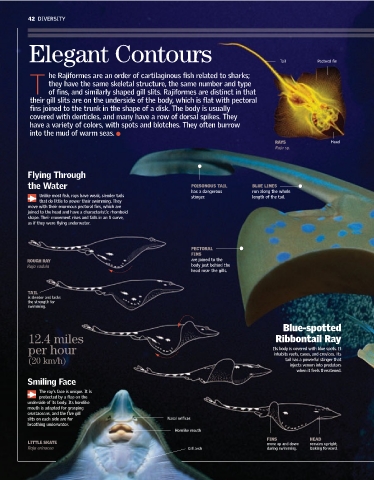
                 he Rajiformes are an order of cartilaginous fish related to sharks;
                                                                                                                                                                 THERE ARE             Gill arch
                 they have the same skeletal structure, the same number and type
                                                                                                                                                                  ABOUT
           T of fins, and similarly shaped gill slits. Rajiformes are distinct in that                                                        BLUE-SPOTTED
                                                                                                                                              RIBBONTAIL RAY                            Muscle
           their gill slits are on the underside of the body, which is flat with pectoral                                                     Taeniura lymma   300
           fins joined to the trunk in the shape of a disk. The body is usually
           covered with denticles, and many have a row of dorsal spikes. They                                                                                   SPECIES OF        Electric
           have a variety of colors, with spots and blotches. They often burrow                                                   Habitat  Indian and Pacific oceans  RAJIFORMES  Ray
                                                                                                                                  Diet     Crustaceans
           into the mud of warm seas.                                                                                                                                             Electric rays (Torpedo sp.) are highly
                                                                                                                                  Length   Up to 6.6 feet (2 m)                   active fish with electric organs on each
                                                                                         RAYS              Head                   Poisonous  Yes                                  side of the head. Each electric organ is
                                                                                         Raja sp.
                                                                                                                                                                                  made of numerous disk-shaped cells,
                                                                                                                                                                                  connected in parallel. When all the cells fire
                                                                                                                                                                                  at once, an electric current is discharged into
                                                                                                                                                                                  the water at 220 volts, enough to stun the prey.
          Flying Through
                                                                                                                                                        PELVIC FINS
          the Water                                           POISONOUS TAIL      BLUE LINES                                                            Small in size
                                                              has a dangerous     run along the whole                                                                                                      TAIL WITH
              Unlike most fish, rays have weak, slender tails  stinger.           length of the tail.                                                                             EYES                     ELECTRIC CHARGE
              that do little to power their swimming. They                                                                                                                        Turned outward
          move with their enormous pectoral fins, which are
          joined to the head and have a characteristic rhomboid
          shape. Their movement rises and falls in an S curve,
          as if they were flying underwater.


                                                              PECTORAL
                                                              FINS
          ROUGH RAY                                           are joined to the
          Raja radula                                         body just behind the                                                                                                                                        PECTORAL FINS
                                                              head near the gills.                                                                                                                                        Joined to the head


          TAIL
          is slender and lacks
          the strength for
          swimming.


                                                                                            Blue-spotted
          12.4 miles                                                                      Ribbontail Ray
          per hour                                                                       Its body is covered with blue spots. It
                                                                                         inhabits reefs, caves, and crevices. Its
          (20 km/h)                                                                          tail has a powerful stinger that
                                                                                              injects venom into predators                                                                                           Nasal    Mouth
                                                                                                when it feels threatened.
                                                                                                                                                                                                         Row of teeth  orifices
          Smiling Face
              The ray's face is unique. It is
              protected by a flap on the
          underside of its body. Its hornlike
          mouth is adapted for grasping
          crustaceans, and the five gill                                                                                       COMPARED
          slits on each side are for                   Nasal orifices                                                          FOR SIZE                                                                Sawfish
          breathing underwater.
                                                                                                                               The manta ray is the                                                    Fish of the order Pristiformes have long bodies with an
                                                         Hornlike mouth
                                                                                                                               largest in the world. In                                                unmistakable face, adorned with 32 pairs of denticles on
                                                                                                                               spite of its large size, it is  23 feet (7 m)  8.2 feet (2.5 m)  3.3 feet (1 m)  each side. The females give birth to 15 to 20 young,
                                                                                       FINS          HEAD
          LITTLE SKATE                                                                 move up and down  remains upright,      harmless, feeding only on  MANTA  Weight 3,300  BUTTERFLY  THORNBACK    which are born with a protective membrane over their
          Raja erinacea                                      Gill arch                 during swimming.  looking forward.      sea plankton.      RAY         pounds (1,500 kg)  RAY      RAY          teeth to keep from hurting the mother.
   41   42   43   44   45   46   47   48   49   50   51