


Page 83 - Fish and Amphibians (Britannica Illustrated Science Library)
P. 83
78 AMPHIBIANS                                                                  FISH AND AMPHIBIANS 79


 Newts      Anatomy of a Newt


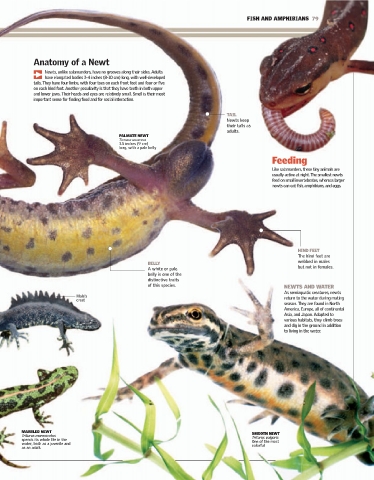
               Newts, unlike salamanders, have no grooves along their sides. Adults
 long with salamanders, newts are the most primitive of terrestrial  FRONT FEET  have elongated bodies 3-4 inches (8-10 cm) long, with well-developed
 vertebrates. Of the three main surviving groups of primitive  Newts have four  tails. They have four limbs, with four toes on each front foot and four or five
 toes on each of  on each hind foot. Another peculiarity is that they have teeth in both upper
 A amphibians, newts most closely resemble the animals from which  their front feet.   and lower jaws. Their heads and eyes are relatively small. Smell is their most
 all amphibians are descended. Some of their habits are also more  important sense for finding food and for social interaction.
 complex and varied. Most of the time they live on land, but during the
 mating season they return to the water. Unlike frogs and toads, newts    TAIL
                                                                          Newts keep
 and salamanders keep their tails as adults. They are found in temperate  their tails as
 regions of the Northern Hemisphere.   PALMATE NEWT                       adults.
                                       TRITURUS HELVETICUS
                                       3.5 inches (9 cm)
                                       long, with a pale belly
 Courtship and Reproduction                                                             Feeding
 NEWTS
                                                                                        Like salamanders, these tiny animals are
 Courtship and mating involve a showy exhibition by both male and
                                                                                        usually active at night. The smallest newts
 female. The male must find a female of the same species and bring
 her a packet of sperm, which he deposits on the ground or in a pool.                   feed on small invertebrates, whereas larger
 Fertilization is internal, and the female gathers the packet into her cloaca.          newts can eat fish, amphibians, and eggs.
 Habitat  Northern Hemisphere
 Number of species  360
 1  DANCE   Order  Urodela
 Males are attracted by
 the female's belly,
 swollen with eggs. The
 males draw her
 attention with their
 showy pigmentation and  Newt Species
 the flexible crest along
 Amphibians are divided into three
 their back and tail.                                                                            HIND FEET
 groups, distinguished by their tails                                                            The hind feet are
 2  EXHIBITION  and legs. Newts and salamanders have  BELLY                                      webbed in males
 The male swims in front  tails and belong to the order Urodela.                                 but not in females.
 of the female, displaying  Some produce toxic substances for  A white or pale
 his nuptial attire. He  defense from predators. They are very  belly is one of the
 raises the toothed crest  small; the largest newt may reach 6 inches  distinctive traits
 on his back and slaps  (15 cm) in length.       of this species.                           NEWTS AND WATER
 GREAT CRESTED NEWT
 his tail while producing  Triturus cristatus                                               As semiaquatic creatures, newts
 secretions from his  spends from three to five  Male's                                     return to the water during mating
 months of the year in the water.  crest
 cloacal glands.                                                                            season. They are found in North
                                                                                            America, Europe, all of continental
                                                                                            Asia, and Japan. Adapted to
 3  CONNECTION                                                                              various habitats, they climb trees
 The male deposits his                                                                      and dig in the ground in addition
 packet of sperm and                                                                        to living in the water.
 then gently guides the
 female toward it,
 pushing her with his side.
 The female gathers the
 packet into her cloaca.
 Males have a crest,
 and females have
 only a yellow stripe
 along their backs.
 EASTERN  DEFENSE
 NEWT  Some newts are highly
 Notophthalmus
 viridescens   dangerous because they
 4  EGG LAYING  The larvae go  release a toxic substance
 Egg  After the eggs are  through a  when attacked. One such
 fertilized, the female  special juvenile
 stage called the  species is the California
 finds a place to  “red phase.”  newt. It can be
 deposit them,  recognized by its bright  MARBLED NEWT                            SMOOTH NEWT
 attaching them to  Triturus marmoratus
 coloring, which serves as                                                        Triturus vulgaris
 underwater  spends its whole life in the                                         One of the most
 a warning to predators.  water, both as a juvenile and
 vegetation or rocks.  as an adult.                                               colorful

