


Page 80 - Fish and Amphibians (Britannica Illustrated Science Library)
P. 80
76 AMPHIBIANS FISH AND AMPHIBIANS 77
A Very Peculiar Tail EYE
Large and bulging,
with a dark-brown iris
Tongue pad
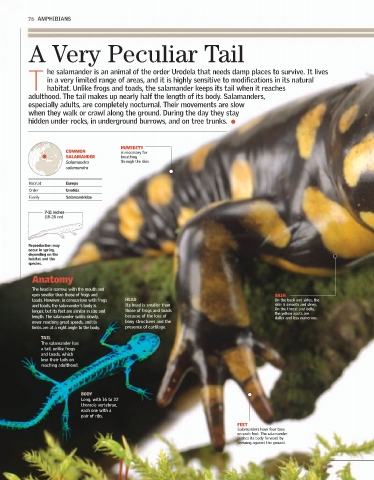
he salamander is an animal of the order Urodela that needs damp places to survive. It lives
in a very limited range of areas, and it is highly sensitive to modifications in its natural The tongue
T habitat. Unlike frogs and toads, the salamander keeps its tail when it reaches muscles retract.
adulthood. The tail makes up nearly half the length of its body. Salamanders,
especially adults, are completely nocturnal. Their movements are slow
when they walk or crawl along the ground. During the day they stay
hidden under rocks, in underground burrows, and on tree trunks.
Outer section
of the tongue
HUMIDITY
COMMON is necessary for Retractor
SALAMANDER breathing muscles
Salamandra through the skin.
salamandra
Feeding Habits
Habitat Europe
CWith its long tongue, the salamander can trap
Order Urodela
its prey in a flash and quickly gulp it down. These
Family Salamandridae carnivorous animals use mainly sight and smell to
hunt. Because they are not very active,
salamanders need relatively small amounts of
7-11 inches food. If they obtain more food than necessary,
(18-28 cm)
they store it as fat for lean times.
Reproduction may
occur in spring,
depending on the
habitat and the
species.
Life Cycle
There are three stages to the life cycle: egg, larva, ITALIAN
Anatomy and adult. The eggs vary in size depending on the SALAMANDER
species. Larvae have feathery external gills.
The head is narrow, with the mouth and Metamorphosis lasts until adulthood, when
eyes smaller than those of frogs and SKIN the salamander loses its gills and
toads. However, in comparison with frogs HEAD On the back and sides, the switches to breathing with Defense
and toads, the salamander's body is Its head is smaller than skin is smooth and shiny. lungs. 1 EGG
longer, but its feet are similar in size and those of frogs and toads On the throat and belly, Hatches into The Italian spectacled salamander has two ways
the yellow spots are
length. The salamander walks slowly, because of the loss of duller and less numerous. a larva of avoiding its enemies. It plays dead, or it curls
never reaching great speeds, and its bony structures and the its tail forward. Other species defend themselves
limbs are at a right angle to the body. presence of cartilage. by using a toxic substance produced by glands or
by breaking off the tail, which continues to move
TAIL on its own and confuses the predator.
The salamander has
a tail, unlike frogs
and toads, which 2 BIRTH
lose their tails on The larva is born
reaching adulthood. 55 years with feathery
ADULT external gills.
3
Metamorphosis
is completed; LIFE SPAN OF SOME SPECIES
the salamander
reaches sexual
BODY
maturity.
Long, with 16 to 22
thoracic vertebrae, LARGE ALPINE
each one with a SALAMANDER
pair of ribs. Salamandra lanzai
FEET LARVA 38 is known for having
Salamanders have four toes CHANGE Metamorphosis begins;
on each foot. The salamander The body grows longer; months the longest gestational
pushes its body forward by the salamander begins the salamander loses period of all animals,
pressing against the ground. its gills and switches even longer than that
to breathe through the
skin and lungs. to breathing air. GESTATIONAL PERIOD of elephants.

