


Page 79 - Fish and Amphibians (Britannica Illustrated Science Library)
P. 79
74 AMPHIBIANS                                                                           FISH AND AMPHIBIANS 75


 Axolotl     Regeneration                                            Mythology

                 Another trait of the axolotl is its outstanding
                 ability to regenerate its extremities and other     In Aztec mythology, the axolotl (atl means “water” and xolotl
                                                                     means “monster”) is the aquatic form of Xólotl, the god for
 his plump amphibian is a classic example of neoteny—the ability to reproduce without  parts of the body, including parts of its head. It can
             regenerate itself through the proliferation of stem     which it is named. Xólotl feared death, refused to accept it, and
 developing completely into an adult. The axolotl has a flat tail and large external gills,  cells in the affected area. These cells multiply and  sought to escape it using his powers of transformation. The
 T which most salamanders lose when they reach maturity and begin to live on land. The  differentiate to replace the missing tissue.  legend recounts that, to flee Death, he ran to the water, where
             Interestingly, the ability to regenerate is shared by   he became the fish called axolotl. This action becomes his final
 axolotl is mostly nocturnal and feeds chiefly on invertebrates. It, in turn, can wind up as the  other amphibians of the order Urodela.  metamorphosis, because Death finally finds him
                                                                     and kills him.
 prey of a water bird. The axolotl was once considered a delicacy, but it is now legally protected.


 Neoteny
 Lake  Latitude
 Zumpango  One of this animal's notable traits
 AXOLOTL  99°
 is neoteny—that is, reaching sexual
 Ambystoma  maturity while in a larval stage, never
 mexicanum  LAKE
 XOCHIMILCO  experiencing metamorphosis. Neoteny is
 Lake  caused by low levels or the complete
 is the only place on
 Xaltocan  absence of thyroxine as the result of a
 the planet where
 low-functioning thyroid gland. In axolotls,
 Habitat  Mexico (Lake Xochimilco)  the axolotl is found
 in the wild.  Longitude   thyroxine can be generated under
 19° 30  experimental conditions by
 Habits  Mainly aquatic  administering iodine.
 Length  10-12 inches (25-30 cm)
 Tenochtitlán
 Life span  25 years
 Lake
 Texcoco
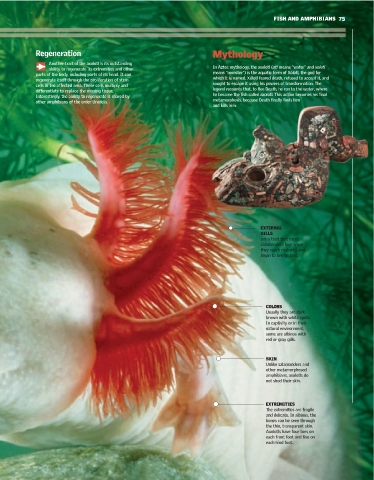
                                                                                     EXTERNAL
                                                                                     GILLS
                                                                                     are a trait that most
 Lake
 Lake  Chalco                                                                        salamanders lose when
 Weight   Xochimilco  12 inches                                                      they reach maturity and
 1.5 pounds (0.7 kg)
 12 inches                                                                           begin to live on land.
 (30 cm)  (30 cm)
 Life Cycle  An adult axolotl can be 10 to
 12 inches (25-30 cm) long.
 The female lays a large number of eggs. The
 time of incubation depends largely on the
 temperature. At 60° F (16° C), incubation averages
 19 days. At the age of six months, the animals are
                                                                                      COLORS
 very active swimmers. They reach sexual maturity                                     Usually they are dark
 at one year of age and adult size at between two                                     brown with white spots.
 and three years, never losing certain anatomical and                                 In captivity or in their
 physiological traits of the larval stage.
                                                                                      natural environment,
                                                                                      some are albinos with
                                                                                      red or gray gills.
                                                                                      SKIN
                                                                                      Unlike salamanders and
                                                                                      other metamorphosed
                                                                                      amphibians, axolotls do
 ADULT                                                                                not shed their skin.
 At two or three
 years of age
 EGGS                                                                                 EXTREMITIES
                                                                                      The extremities are fragile
                                                                                      and delicate. In albinos, the
                                                                                      bones can be seen through
 FULL-GROWN
                                                                                      the thin, transparent skin.
                                                                                      Axolotls have four toes on
                                                                                      each front foot and five on
 LARVA                                                                                each hind foot.

