


Page 91 - Fish and Amphibians (Britannica Illustrated Science Library)
P. 91
86 PEOPLE, FISH, AND AMPHIBIANS                                                         FISH AND AMPHIBIANS 87


 Lures, Flies, and Bait                                                                              Wings that

                    They   hear the lure.            Fishing Strategies                              imitate those
                                                     Fishing with a fly, with a hook, with bait,     of a fly
                    SUCCESS DEPENDS ON BOTH THE LOOK
 o spot, watch, cast the bait, and catch the fish. Humans and fish, face to face in  AND THE SOUND OF THE LURE.  and with lures. Every sportfishing species
                                                     has its own challenges and thus demands
 hand-to-hand combat. Every fisherman or fisherwoman is a hunter, and knowledge  distinct strategies.
 T of the prey is the basis of success. To catch fish, it is necessary to know their habits  Rainbow trout can be
 and preferences. Fishing methods, from fly-fishing to the use of cutting-edge technology,  recognized by the red spot  The artificial
                              on the operculum bone.                                                     fly is set on
 such as that used to catch tuna, depend on the area, the fish species, and available                    top of a
                                                                                                         hook.
 resources. Choosing the right morsel to tempt the fish (whether real or artificial bait) is
 another important decision. The key is to know which bait to use among the wide    Fly-fishing
 variety available and how to present it.                                           is the most popular method among those
                                                                                    fishing for rainbow trout. As the trout feed
                                                                                    on surface insects, they are attracted by
                                                                                    artificial flies that the fishermen cast.

 Where to Find Them  Adipose fin,
 Knowing how fish breathe can be very  present only in
 useful for finding them. Arctic char, salmon,  the Salmonidae
 and most trout require well-oxygenated  family
 waters. They generally live in cold rivers at
 specific elevations, where the
 water is clear and clean.                                                          Fishing with bait
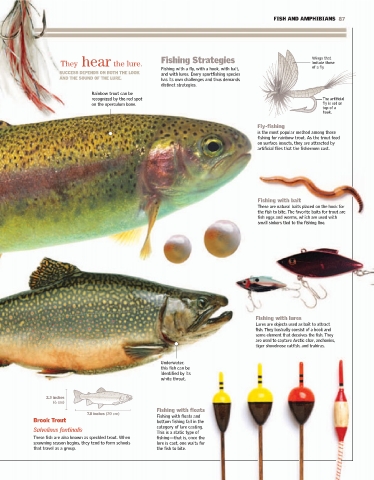
                                                                                    These are natural baits placed on the hook for
                                                                                    the fish to bite. The favorite baits for trout are
                                                                                    fish eggs and worms, which are used with
 Fresh                                                                              small sinkers tied to the fishing line.

 water

 IS THE TYPE OF WATER
 WHERE MOST SPORTFISHING
 TAKES PLACE.
 Wild specimens
 The tail has many spots, and they  are thinner than
 clearly differentiate the rainbow  those in
 trout from the common trout.  breeding farms.

 2.7 inches
 (7 cm)
 9.8 inches (25 cm)
 Rainbow Trout                                                                     Fishing with lures
 Oncorhynchus mykiss                                                               Lures are objects used as bait to attract
 The most popular species for sportfishing,                                        fish. They basically consist of a hook and
 this trout looks athletic and elegant, and it                                     some element that deceives the fish. They
 will attack anything that looks like food.                                        are used to capture Arctic char, anchovies,
 Fishing with a hook                                                               tiger shovelnose catfish, and trahiras.
 This hook holds a piece of food that is
 tempting to the fish, so that when the  2  ACTION
 fish bites, it will be hooked. Hooks are  The fish has seen the fly. The fish turns  Underwater,
 tied to a line connected to the fishing rod.  toward the fly, and when it takes the  this fish can be
 lure, the fishing line must be reeled               identified by its
 in quickly.                                         white throat.
 Its tail is  Fins with white
 square-shaped  borders are
 and clearly  characteristic
 Camouflaged    2.3 inches
 jacket to  forked.  of this species.  (6 cm)
 avoid
 frightening                                       Fishing with floats
 pounds     Brook Trout                            Fishing with floats and
 the fish                    7.8 inches (20 cm)
                                                   bottom fishing fall in the
 1  CASTING  Waders allow  3  COMBAT  39 (18 kg)  Salvelinus fontinalis  category of lure casting.
 the fisherman
 Once the fish is targeted,  or fisherwoman  Once it has taken the  This is a static type of
 it only takes one or two  to approach  lure, the trout begins to  TROUT COME IN DIFFERENT  These fish are also known as speckled trout. When  fishing—that is, once the
 tries for the animal to  and make the  fight by diving and  SIZES, FROM 3.5 OUNCES   spawning season begins, they tend to form schools  lure is cast, one waits for
 become suspicious.  crucial cast.  “sprinting” at high speed.  (100 G) TO 39 POUNDS (18 KG).  that travel as a group.  the fish to bite.

