


Page 92 - Fish and Amphibians (Britannica Illustrated Science Library)
P. 92
88 PEOPLE, FISH, AND AMPHIBIANS FISH AND AMPHIBIANS 89
Endangered Species WHALE COMMON
SHARK SKATE
ndiscriminate hunting, overfishing, and pollution of Rhincodon Dipturus batis
the oceans have pushed many species to the brink of typus
I extinction. Sharks and rays are among the first marine life- Status Endangered Status Vulnerable
forms to be systematically studied, and 20 percent of their 547 Cause Indiscriminate fishing Cause Overfishing
species are in danger of disappearing. Slow-growing species are Range Warm seas Range Eastern Atlantic
especially susceptible to excessive fishing. Although it is recognized as the largest This fish can reach a length of 8 feet (2.5
fish in the world, little is known about m). It has disappeared from many areas
the whale shark. It can grow to a of Europe, where it was once common. It
length of nearly 60 feet (18 m), and it is still fished commercially, however. The
lives in warm seas all over the world. common skate's large size makes it easy
This fish takes some time to reproduce to catch in nets. It lives in the eastern
Fish in Danger because females do not reach sexual Atlantic, the western Mediterranean, and
maturity until they are 20 years of age. the western Baltic Sea.
The situation is especially critical for angel sharks (Squatina
squatina) and for the common, or blue, skate (Dipturus batis).
The angel shark has now been declared extinct in the North Sea (af-
ter having been moved from “vulnerable” to “critically endangered”
status), as has the common skate (which has been moved from “en-
dangered” to “critically endangered”). The common skate is very
scarce in the Irish Sea and in the southern part of the North Sea. As
fishing operations have moved to deeper waters, the gulper shark
(Centrophorus granulosus) has also suffered a substantial decline,
and it is now in the “vulnerable” category.
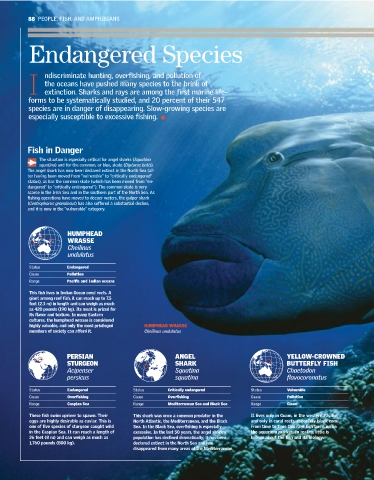
HUMPHEAD
WRASSE
Cheilinus DWARF SEAHORSE
undulatus Seahorses eat mainly
small crustaceans
(copepods, amphipods,
Status Endangered isopods, and ostracods),
which it sucks into its
Cause Pollution
tubular mouth.
Range Pacific and Indian oceans
This fish lives in Indian Ocean coral reefs. A
giant among reef fish, it can reach up to 7.5
feet (2.3 m) in length and can weigh as much
as 420 pounds (190 kg). Its meat is prized for
its flavor and texture. In many Eastern
cultures, the humphead wrasse is considered
highly valuable, and only the most privileged HUMPHEAD WRASSE
members of society can afford it. Cheilinus undulatus
PERSIAN ANGEL YELLOW-CROWNED PYGMY
STURGEON SHARK BUTTERFLY FISH SEAHORSE
Acipenser Squatina Chaetodon Hippocampus
persicus squatina flavocoronatus bargibanti
Status Endangered Status Critically endangered Status Vulnerable Status Endangered
Cause Overfishing Cause Overfishing Cause Pollution Cause Pollution
Range Caspian Sea Range Mediterranean Sea and Black Sea Range Guam Range Caribbean Sea
These fish swim upriver to spawn. Their This shark was once a common predator in the It lives only in Guam, in the western Pacific, Most seahorses are quite small, from the
eggs are highly desirable as caviar. This is North Atlantic, the Mediterranean, and the Black and only in coral reefs, especially black coral. dwarf seahorse in the Gulf of Mexico, at 1 inch
one of five species of sturgeon caught wild Sea. In the Black Sea, overfishing is especially From time to time this rare fish turns up on (2.5 cm), to the giant seahorse in the Pacific,
in the Caspian Sea. It can reach a length of excessive. In the last 50 years, the angel shark's the aquarium market. In reality, little is at 13.7 inches (35 cm). In European waters,
26 feet (8 m) and can weigh as much as population has declined dramatically; it has been known about the fish and its biology. seahorses have an average length of 6 inches
1,760 pounds (800 kg). declared extinct in the North Sea and has (15 cm). They use color as protection from the
disappeared from many areas of the Mediterranean. fish and fauna that share their habitat.

