


Page 40 - BBC Wildlife Volume 36 #06
P. 40
SPINY LOBSTERS


                  ake 18 bounding strides down your street and
                  the odds are it will look much the same at the
                  end as it does at the beginning. Yet that is as
                  far as I had to go to enter a completely alien
                  world. Two rusty boilers standing bolt upright
                  under 18m of water are all that remain of
         Tthe wreck of a steamship that hit a mine in
          December 1917 and sank off Cornwall’s Lizard Peninsula.
          All manner of weird and wonderful marine life has
          colonised the artificial reef that this wartime disaster
          created, yet at the surface there’s no clue it even exists.
           In March I joined a dive survey team from the
          Cornwall Wildlife Trust and the Cornwall Inshore
          Fisheries Conservation Association (CIFCA) on the
          wreck. Our aim was to investigate the wholly unexpected
          reappearance of the European spiny lobster, also known
          as the crawfish, which had all but disappeared by the end
          of the 1990s, after a just few decades of overfishing by
          divers and the introduction of new monofilament nets.
           This handsome crustacean, with its impressively long
          antennae and heavily armoured body, has a wide range
          from northern Scotland south to the Mediterranean.
          Although it favours warm climes, currents generated
          by the Gulf Stream flush our western shores with  ON CLOSER INSPECTION,
          warm water from as far away as the Florida Straits,
          enabling it to thrive along British and Irish coasts. A  THESE ANIMALS HAVE HABITS
          handful of faded photos of divers proudly displaying
          giant specimens hark back to a time when the species  STRANGE ENOUGH TO RIVAL ANY
                                                         SCIENCE-FICTION CHARACTER.
          supported an important UK fishery.
          DISTANT RELATIVES
          Spiny lobsters are a feisty family of about 60 species
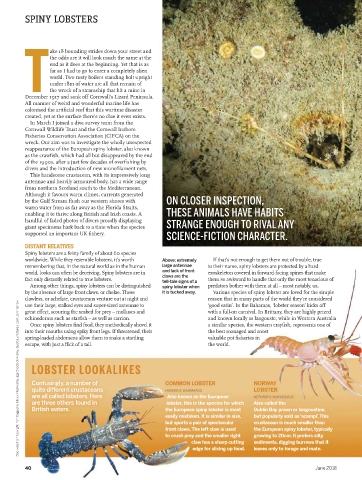
          worldwide. While they resemble lobsters, it’s worth  Above: extremely  If that’s not enough to get them out of trouble, true
          remembering that, in the natural world as in the human  large antennae  to their name, spiny lobsters are protected by a hard
          world, looks can often be deceiving. Spiny lobsters are in   and lack of front  exoskeleton covered in forward-facing spines that make
                                                        claws are the
          fact only distantly related to true lobsters.                them so awkward to handle that only the most tenacious of
                                                        tell-tale signs of a
           Among other things, spiny lobsters can be distinguished  spiny lobster when  predators bother with them at all – most notably, us.
          by the absence of large front claws, or chelae. These  it is tucked away.  Various species of spiny lobster are loved for the simple
          clawless, or achelate, crustaceans venture out at night and  reason that in many parts of the world they’re considered
       Clockwise from top r ght: Tom Daguerre; blickwinkel/A amy; age fotostock/A amy; Sue Da y/naturep .com; John Yarrow
          use their large, stalked eyes and super-sized antennae to    ‘good eatin’. In the Bahamas, ‘lobster season’ kicks off
          great effect, scouring the seabed for prey – molluscs and    with a full-on carnival. In Brittany, they are highly prized
          echinoderms such as starfish – as well as carrion.            and known locally as langouste, while in Western Australia
           Once spiny lobsters find food, they methodically shovel it   a similar species, the western crayfish, represents one of
          into their mouths using spiky front legs. If threatened, their  the best managed and most
          spring-loaded abdomens allow them to make a startling        valuable pot fisheries in
          escape, with just a flick of a tail.                          the world.


            LOBSTER LOOKALIKES

            Confusingly, a number of                     COMMON LOBSTER                NORWAY
            quite diferent crustaceans                   HOMARUS GAMMARUS              LOBSTER
            are all called lobsters. Here                 Also known as the European   NEPHROPS NORVEGICUS
            are three others found in                    lobster, this is the species for which   Also called the
            British waters.                              the European spiny lobster is most   Dublin Bay prawn or langoustine,
                                                         easily mistaken. It is similar in size,   but popularly sold as ‘scampi’. This
                                                         but sports a pair of spectacular   crustacean is much smaller than
                                                         front claws. The left claw is used   the European spiny lobster, typically
                                                         to crush prey and the smaller right   growing to 20cm. It prefers silty
                                                                  claw has a sharp cutting   sediments, digging burrows that it
                                                                  edge for slicing up food.  leaves only to forage and mate.


          40                                                                                                June 2018

