


Page 42 - BBC Wildlife Volume 36 #06
P. 42
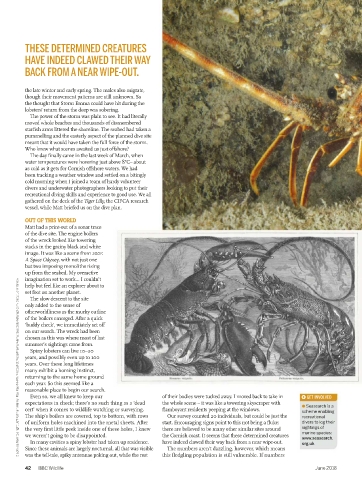
THESE DETERMINED CREATURES

          HAVE INDEED CLAWED THEIR WAY
          BACK FROM A NEAR WIPE-OUT.


          the late winter and early spring. The males also migrate,
          though their movement patterns are still unknown. So
          the thought that Storm Emma could have hit during the
          lobsters’ return from the deep was sobering.
           The power of the storm was plain to see. It had literally
          moved whole beaches and thousands of dismembered
          starfish arms littered the shoreline. The seabed had taken a
          pummelling and the easterly aspect of the planned dive site
          meant that it would have taken the full force of the storm.
          Who knew what scenes awaited us just offshore?
           The day finally came in the last week of March, when
          water temperatures were hovering just above 8°C– about
          as cold as it gets for Cornish offshore waters. We had
          been tracking a weather window and settled on a bitingly
          cold morning when I joined a team of hardy volunteer
          divers and underwater photographers looking to put their
          recreational diving skills and experience to good use. We all
          gathered on the deck of the Tiger Lilly, the CIFCA research
          vessel, while Matt briefed us on the dive plan.

          OUT OF THIS WORLD
          Matt had a print-out of a sonar trace
          of the dive site. The engine boilers
          of the wreck looked like towering
          stacks in the grainy black and white
          image. It was like a scene from 2001:
          A Space Odyssey, with not just one
          but two imposing monoliths rising
          up from the seabed. My overactive
          imagination set to work… I couldn’t
       Clockwise from top right: Jef Rotman/Alamy; Paul Kay/NHPA/Photoshot; WaterFrame/Alamy; Sue Daly/naturepl.com; Getty: John Yarrow
          help but feel like an explorer about to
          set foot on another planet.
           The slow descent to the site
          only added to the sense of
          otherworldliness as the murky outline
          of the boilers emerged. After a quick
          ‘buddy check’, we immediately set off
          on our search. The wreck had been
          chosen as this was where most of last
          summer’s sightings came from.
           Spiny lobsters can live 10–20
          years, and possibly even up to 100
          years. Over these long lifetimes
          many exhibit a homing instinct,
          returning to the same home ground
          each year. So this seemed like a
          reasonable place to begin our search.
           Even so, we all knew to keep our             of their bodies were tucked away. I moved back to take in   + GET INVOLVED
          expectations in check; there’s no such thing as a ‘dead   the whole scene – it was like a towering skyscraper with
                                                                                                       O Seasearch is a
          cert’ when it comes to wildlife watching or surveying.   flamboyant residents peeping at the windows.
                                                                                                       scheme enabling
          The ship’s boilers are covered, top to bottom, with rows   Our survey counted 20 individuals, but could be just the   recreational
          of uniform holes machined into the metal sheets. After   start. Encouraging signs point to this not being a fluke:   divers to log their
          the very first little peek inside one of these holes, I knew   there are believed to be many other similar sites around   sightings of
                                                                                                       marine species:
          we weren’t going to be disappointed.          the Cornish coast. It seems that these determined creatures
                                                                                                       www.seasearch.
           In many cavities a spiny lobster had taken up residence.   have indeed clawed their way back from a near wipe-out.   org.uk
          Since these animals are largely nocturnal, all that was visible   The numbers aren’t dazzling, however, which means
          was the tell-tale, spiky antennae poking out, while the rest   this fledgling population is still vulnerable. If numbers
          42  BBC Wildlife                                                                                  June 2018

