


Page 43 - BBC Wildlife Volume 36 #06
P. 43
SPINY LOBSTERS


                                                            LIFE-CYCLE: FROM EGG TO ADULT

                                                            Spiny lobsters undergo a magical metamorphosis, with juvenile
                                                            stages that look nothing like full-grown adults.

                                                            EGG
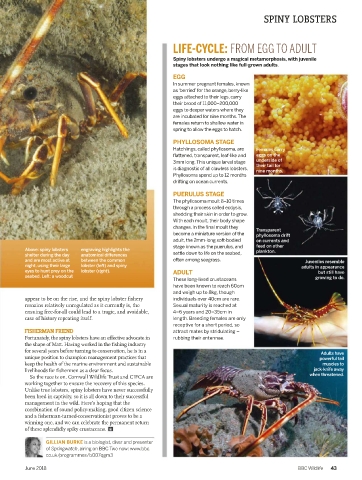
                                                            In summer pregnant females, known
                                                            as ‘berried’ for the orange, berry-like
                                                            eggs attached to their legs, carry
                                                            their brood of 11,000–200,000
                                                            eggs to deeper waters where they
                                                            are incubated for nine months. The
                                                            females return to shallow water in
                                                            spring to allow the eggs to hatch.

                                                            PHYLLOSOMA STAGE
                                                            Hatchlings, called phyllosoma, are   Females carry
                                                            flattened, transparent, leaf-like and   eggs on the
                                                            3mm long. This unique larval stage   underside of
                                                                                        their tail for
                                                            is diagnostic of all clawless lobsters.
                                                                                        nine months.
                                                            Phyllosoma spend up to 12 months
                                                            drifting on ocean currents.
                                                            PUERULUS STAGE
                                                            The phyllosoma moult 8–10 times
                                                            through a process called ecdysis,
                                                            shedding their skin in order to grow.
                                                            With each moult, their body shape
                                                            changes. In the final moult they
                                                                                        Transparent
                                                            become a miniature version of the   phyllosoma drift
                                                            adult, the 2mm-long soft-bodied   on currents and
                                                            stage known as the puerulus, and   feed on other
         Above: spiny lobsters   engraving highlights the                               plankton.
         shelter during the day   anatomical differences    settle down to life on the seabed,
         and are most active at   between the common        often among seagrass.                       Juveniles resemble
         night, using their large   lobster (left) and spiny                                           adults in appearance
         eyes to hunt prey on the   lobster (right).        ADULT                                            but still have
         seabed. Left: a woodcut                                                                            growing to do.
                                                            These long-lived crustaceans
                                                            have been known to reach 60cm
                                                            and weigh up to 8kg, though
         appear to be on the rise, and the spiny lobster fishery   individuals over 40cm are rare.
         remains relatively unregulated as it currently is, the   Sexual maturity is reached at
         ensuing free-for-all could lead to a tragic, and avoidable,   4–6 years and 20–35cm in
         case of history repeating itself.                  length. Breeding females are only
                                                            receptive for a short period, so
         FISHERMAN FRIEND                                   attract mates by stridulating –
         Fortunately, the spiny lobsters have an effective advocate in   rubbing their antennae.
         the shape of Matt. Having worked in the fishing industry
         for several years before turning to conservation, he is in a
                                                                                                              Adults have
         unique position to champion management practices that                                               powerful tail
         keep the health of the marine environment and sustainable                                            muscles to
         livelihoods for fishermen as a clear focus.                                                        jack-knife away
                                                                                                          when threatened.
           So the race is on. Cornwall Wildlife Trust and CIFCA are
         working together to ensure the recovery of this species.
         Unlike true lobsters, spiny lobsters have never successfully
         been bred in captivity, so it is all down to their successful
         management in the wild. Here’s hoping that the
         combination of sound policy-making, good citizen science
         and a fisherman-turned-conservationist proves to be a
         winning one, and we can celebrate the permanent return
         of these splendidly spiky crustaceans.

                 GILLIAN BURKE is a biologist, diver and presenter
                 of Springwatch, airing on BBC Two now: www.bbc.
                 co.uk/programmes/b007qgm3
          June 2018                                                                                   BBC Wildlife  43

