


Page 33 - World of Animals - Issue #39
P. 33
Slow loris


              1. Venom

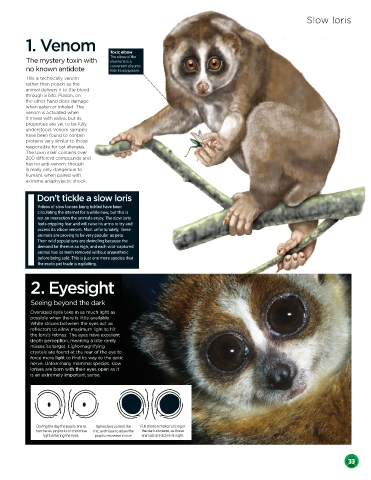
                                            Toxic elbow
              The mystery toxin with        The elbow of the
                                            slow loris is a
              no known antidote             convenient place to
                                            hide its oily poison.
              This is technically venom
              rather than poison as the
              animal delivers it to the blood
              through a bite. Poison, on
              the other hand does damage
              when eaten or inhaled. The
              venom is activated when
              it mixes with saliva, but its
              properties are yet to be fully
              understood. Venom samples
              have been found to contain
              proteins very similar to those
              responsible for cat allergies.
              The toxin itself contains over
              200 different compounds and
              has no anti-venom, though
              is really only dangerous to
              humans when paired with
              extreme anaphylactic shock.


                  Don’t tickle a slow loris
                  Videos of slow lorises being tickled have been
                  circulating the internet for a while now, but this is
                  not an interaction the animals enjoy. The slow loris
                  feels crippling fear and will raise its arms to try and
                  access its elbow venom. Most unfortunately, these
                  animals are proving to be very popular as pets.
                  Their wild populations are dwindling because the
                  demand for them is so high, and each wild-captured
                  animal has its teeth removed without anaesthetic
                  before being sold. This is just one more species that
                  the exotic pet trade is exploiting.

                2. Eyesight


                Seeing beyond the dark
                Oversized eyes take in as much light as
                possible when there is little available.
                White stripes between the eyes act as
                reflectors to allow maximum light to hit

                the loris’s retinas. The eyes have excellent
                depth perception, meaning a bite rarely
                misses its target. Light-magnifying
                crystals are found at the rear of the eye to

                force more light to find its way to the optic
                nerve. Unlike many mammal species, slow
                lorises are born with their eyes open as it
                is an extremely important sense.


                  During the day the pupils are as   Sphincters control the   Full dilation makes seeing in
                  narrow as pinpricks to minimise   iris, and relax to allow the   the dark a breeze, as these
                     light entering the eyes.  pupil to increase in size.  animals are active at night.


                                                                                                                               33


       030-035_Cute but deadly_Slow loris.indd   33                                                                          12/10/2016   14:58

