


Page 29 - World of Animals - Issue #39
P. 29
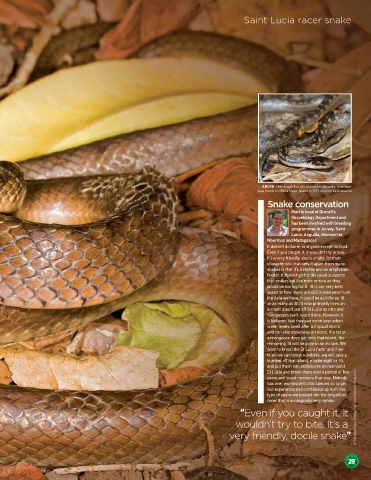
Saint Lucia racer snake
ABOVE A er it was thought extinct for decades, one racer
was found on Maria Major Island in 1973 proving its existence
Snake conservation
Matt is head of Durrell’s
Herpetology Department and
has been involved with breeding
programmes in Jersey, Saint
Lucia, Anguilla, Montserrat,
Mauritius and Madagascar.
It doesn’t do harm to anyone except its food.
Even if you caught it, it wouldn’t try to bite.
It’s a very friendly, docile snake. Its main
characteristic that sets it apart from many
snakes is that it’s a reptile and an amphibian
feeder. It doesn’t go for the usual suspects
that snakes eat like mice or rats as they
would be too big for it. 18 is our very best
guess at how many are still in existence from
the data we have. It could be as little as 10
or as many as 30. It now primarily lives on
a small island just off St Lucia as rats and
mongooses can’t reach there. However, it
is believed that they can swim over when
water levels swell aer a tropical storm
and can also stowaway on boats. If a rat or
a mongoose does get onto that island, the
remaining 18 will be gone in an instant. We
want to breed the St Lucia racer and if we
think we can boost numbers, we will take a
number off that island, maybe eight or 10,
and put them into enclosures on mainland
St Lucia and breed them over a period of five
years and boost numbers that way. Nobody
has ever worked with this species so to get
our experience and confidence up with this
type of snake we looked into the Anguillian
racer that is ecologically very similar.
“Even if you caught it, it © Toby Ross/Durrell/G Guida/Matt Goetz; freevectormaps.com
wouldn’t try to bite. It’s a
very friendly, docile snake”
29
28-29_Endangered StLuciaSnake.indd 29 12/10/2016 14:56

