


Page 46 - World of Animals - Issue #39
P. 46
All about the common ostrich


            Dating and mating


            With communal nests and complex mating rituals, ostriches have a very unique style of breeding

            Ostriches usually live in groups of around   The males – also known as cocks or   Communal nests are around three
            ten individuals, but sometimes flocks can   roosters – flap their wings in alternating   metres (ten feet) wide and can contain


            include up to 100 birds. There is a loose   wing beats, showing off their plumage until   up to 60 eggs, although when it comes
            hierarchy; a dominant male and female   a female shows interest. Once paired, they   to incubation, the dominant female will
            head the group, which is made up of   retire to a mating area, where they graze   sometimes remove the eggs of weaker

            several other, less important, females.   together in synchrony. After eating, the   females to ensure only the fittest genes
            Young, lone males also come and go,   male pokes at the ground with its beak   are passed on to the next generation.

            joining the group during mating season   and flaps its wings once more to clear   Although there are numerous eggs, each

            and moving between flocks.          the area of dirt and create a nest. The   female ostrich is able to recognise her own.
              The female at the top of the hierarchy is   female starts to run in circles around the   During the day, the dominant female
            the only one the dominant male will mate   male, whose head winds in a spiral motion,   will sit on and incubate all remaining eggs
            with. As for the other males in the herd,   before the female drops to the ground and   in the nest. Its light coloured feathers act

            they will have to catch a lower ranking   copulation begins.          as camouflage to help it stay safe. When
            female’s attention through a dancing ritual.    When it comes to laying eggs, there is   night falls, the dominant male’s shift
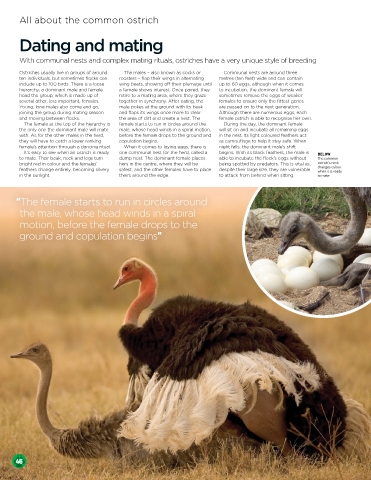
              It’s easy to see when an ostrich is ready   one communal nest for the herd, called a   begins. With its black feathers, the male is   BELOW
            to mate. Their beak, neck and legs turn   dump nest. The dominant female places   able to incubate the flock’s eggs without   The common

            bright red in colour and the females’   hers in the centre, where they will be   being spotted by predators. This is vital as,   ostrich’s neck
            feathers change entirely, becoming silvery   safest, and the other females have to place   despite their large size, they are vulnerable   changes colour
                                                                                                                     when it is ready
            in the sunlight.                   theirs around the edge.            to attack from behind when sitting.  to mate
           “The female starts to run in circles around

            the male, whose head winds in a spiral
            motion, before the female drops to the

            ground and copulation begins”


           46


       044-051_AA Ostrich.indd   46                                                                                          12/10/2016   15:03

