


Page 84 - World of Animals - Issue #39
P. 84
Wildlife of the Sahara Desert
Surviving the desert Where is the Sahara Desert?
The Sahara Desert spans 9.4 million square kilometres (3.6 million
square miles), spreading across the northern countries of Africa
With little food, water or shade, the Sahara Desert is harsh including Algeria, Chad, Egypt, Libya, Mali, Mauritania, Morocco, Niger,
and unforgiving for those that call it home. Despite its extreme Western Sahara, Sudan and Tunisia. While many think of deserts as
conditions, the species that live here are diverse and plentiful vast expanses of sand, just 30 per cent of the Sahara is sandy; the
other 70 per cent is gravel. The desert is similar in size to the United
Life in the desert is challenging, a few survival tricks up their States or China and has as little as 250 millimetres (one inch) of
and finding food and water in this sleeves. Whether it’s the huge rainfall a year.
arid land can mean the difference heat-expelling ears of the fennec
between life and death. With very fox, the sand swimming abilities of
little rainfall, few plants or trees for the skink or the collapsible ribs of
shelter or food, and temperatures the common gundi, many animals
hitting 50 degrees Celsius (122 have developed adaptations to
degrees Fahrenheit) in the midday not only survive, but thrive in this
sun and plummeting to below environment. In fact, some have
zero degrees Celsius at night, it learnt to survive without drinking
really is a battle for survival. But water, instead absorbing their
the animals that live here have water from the plants they eat.
Griffon vulture
Egyptian
plover
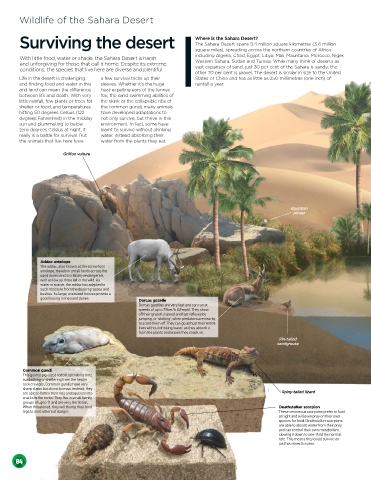
Addax antelope
The addax, also known as the screwhorn
antelope, travels in small herds across the
sand dunes and is critically endangered,
with as few as three le in the wild. As
water is scarce, the addax has adapted to
suck moisture from the desert grasses and
bushes. Its large, oversized hooves provide a
good footing in the sand dunes.
Dorcas gazelle
Dorcas gazelles are very fast and can run at
speeds of up to 79km/h (49mph). They show
off their graceful speed and fast reflexes by
jumping, or ‘stotting’, when predators are nearby
to scare them off. They can go almost their entire
lives without drinking water, as they absorb it
from the plants and leaves they snack on.
Pin-tailed
sandgrouse
Common gundi
This guinea pig-sized rodent spends its time
sunbathing or sheltering from the heat in
rock crevices. Common gundis have very
sharp claws but do not burrow. Instead, they
are able to flatten their ribs and squeeze into Spiny-tailed lizard
cracks in the rocks. They live in small family
groups of up to 11 and are very territorial.
When threatened, they will thump their hind Deathstalker scorpion
legs to alert others of danger. These venomous scorpions prefer to hunt
at night and will even prey on their own
species for food. Deathstalker scorpions
are able to absorb water from their prey
and can control their own metabolism,
slowing it down to one-third the normal
rate. This means they could survive on
just two insects a year.
84
082-085 WildlifeofSahara.indd 84 12/10/2016 17:44

