


Page 85 - World of Animals - Issue #39
P. 85
Wildlife of the Sahara Desert


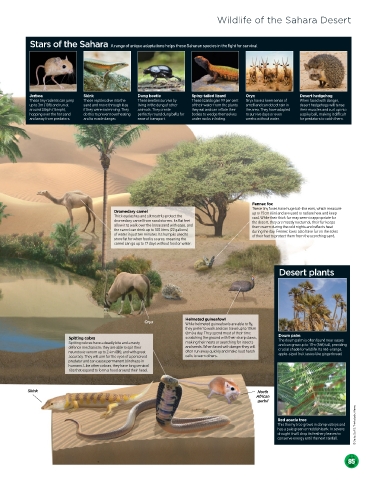
                Stars of the Sahara A range of unique adaptations helps these Saharan species in the fi ght for survival


                Jerboa             Skink              Dung beetle        Spiny-tailed lizard  Oryx             Desert hedgehog
                These tiny rodents can jump   These reptiles dive into the   These beetles survive by   These lizards gain 99 per cent   Oryx have a keen sense of   When faced with danger,

                up to 3m (10 ) and run at   sand and move through it as   living in the dung of other   of their water from the plants   smell and can detect rain in   desert hedgehogs will tense

                around 26kph (16mph),   if they were swimming. They   animals. They create   they eat and can inflate their   the area. They have adapted   their muscles and curl up into

                hopping over the hot sand   do this to prevent overheating   perfectly round dung balls for   bodies to wedge themselves   to survive days or even   a spiky ball, making it diffi cult
                and away from predators.   and to evade danger.  ease of transport.   under rocks in hiding.  weeks without water.  for predators to catch them.


                                                                                              Fennec fox
                                                                                              These tiny foxes have huge bat-like ears, which measure
                                             Dromedary camel                                  up to 15cm (6in) and are used to radiate heat and keep
                                             Thick eyelashes and slit nostrils protect the    cool. While their thick fur may seem inappropriate for
                                             dromedary camel from sand storms. Its flat feet   the desert, they are mostly nocturnal; their fur keeps

                                             allow it to walk over the loose sand with ease, and   them warm during the cold nights and reflects heat

                                             the camel can drink up to 100 litres (22 gallons)   during the day. Fennec foxes also have fur on the soles
                                             of water in just ten minutes. Its hump is used to   of their feet to protect them from the scorching sand.
                                             store fat for when food is scarce, meaning the
                                             camel can go up to 17 days without food or water.

                                                                                                       Desert plants


                                                                      Helmeted guineafowl
                                                        Oryx          While helmeted guineafowls are able to fly,

                                                                      they prefer to walk and can travel up to 10km
                                                                      (6mi) a day. They spend most of their time
                             Spitting cobra                           scratching the ground with their sharp claws,   Doum palm
                                                                                                       The doum palm is o en found near oases
                             Spitting cobras have a deadly bite and a nasty   making their nests or searching for insects   and can grow up to 17m (56 ) tall, providing

                             defence mechanism; they are able to spit their   and seeds. When faced with danger they will   crucial shade for wildlife. Its red-orange,


                             neurotoxic venom up to 2.4m (8 ), and with great   o en run away quickly and make loud harsh   apple-sized fruit tastes like gingerbread.
                             accuracy. They will aim for the eyes of a perceived   calls to warn others.
                             predator and can cause permanent blindness in
                             humans. Like other cobras, they have long cervical
                             ribs that expand to form a hood around their head.
               Skink                                                                            North
                                                                                               African
                                                                                                gerbil

                                                                                                       Red acacia tree
                                                                                                       This thorny tree grows in damp valleys and   © Getty; Sol90; Thinkstock; Alamy
                                                                                                       has a pale green or reddish bark. In severe
                                                                                                       drought it will drop its feathery leaves to
                                                                                                       conserve energy until the next rainfall.


                                                                                                                               85


       082-085 WildlifeofSahara.indd   85                                                                                    12/10/2016   17:47

