


Page 46 - All About History - Issue 27-15
P. 46
Mysteries of the Taj Mahal


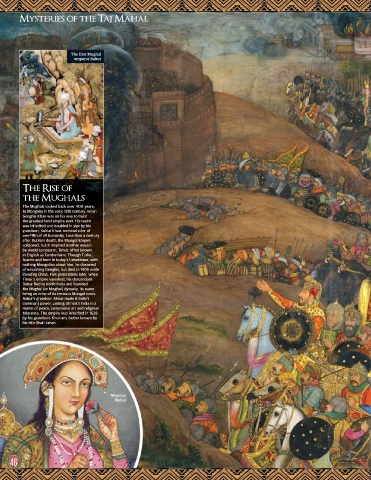
                          The first Mughal
                           emperor Babur


         The Rise of
         the Mughals
         The Mughals looked back over 400 years,
         to Mongolia in the early 13th century, when
         Genghis Khan was on his way to build
         the greatest land empire ever. His realm
         was inherited and doubled in size by his
         grandson, Kublai Khan, nominal ruler of
         one-fifth of all humanity. Less than a century
         after Kublai’s death, the Mongol Empire
         collapsed, but it inspired another would-
         be world conqueror, Timur, often known
         in English as Tamburlaine. Though Turkic,
         Islamic and born in today’s Uzbekistan, with
         nothing Mongolian about him, he dreamed
         of emulating Genghis, but died in 1405 while
         invading China. Five generations later, when
         Timur’s empire vanished, his descendant
         Babur fled to north India and founded
         the Mughul (or Moghul) dynasty, its name
         being an echo of its tenuous Mongol roots.
         Babur’s grandson Akbar made it India’s
         dominant power, uniting all north India in a
         model of peace, sumptuous art and religious
         tolerance. The empire was inherited in 1628
         by his grandson, Khurram, better known by
         his title Shah Jahan.


                                        Mumtaz
                                         Mahal


     46

