Page 47 - All About History - Issue 27-15
P. 47
Mysteries of the Taj Mahal


        devoted to each other. The Chronicle records their   He chose well. The site stands on the south bank
        “mutual affection and harmony” and goes on: “The   of the River Yamuna (or Jamna), on a U-bend, with
        intimacy, deep affection, attention and favour that   a view of the river to right and left and within
        his Majesty had for the chosen one of the palace   sight of many of Agra’s 44 riverside gardens, and   Architecture
        exceeded by a thousand times what he felt for any   of the vast fort that was the principal palace of the
        other.” She was also his “associate, companion,   early Mughal emperors. The decision, marked by a   of the
        close confidante and intimate friend.” They were   great feast, was followed by meticulous planning
        seldom apart, even when he was campaigning.   overseen by a master architect named Ahmad   Golden Age
          After he was crowned emperor in 1628, she   Lahawri, a Persian from Badakshan in today’s
        became part of her husband’s lavish court life, and   Afghanistan, who was also the court’s official   Shah Jahan, an expert patron of
        was with him when he led an army to finish the   historian. It is almost certain that Shah Jahan   architecture, saw Mughal styles
        task of conquering the Deccan. In June         himself, an expert in architecture and
        1631 they were in Burhanpur, 700                   decoration, was closely involved   reach their high point. Mughal
        kilometres (434 miles) from Agra,                    with the design, perhaps even    buildings combine domes,
        on the southern fringe of the                          the chief designer.         minarets, halls, vaulted gateways
        empire. Mumtaz, aged 37,           “This                   He had precedents to      and delicate ornamentation
        had borne him 13 children,       resting                 inspire him, in particular
        though only seven had        place for his               Persian traditions and
        survived, and was about                                   the mausoleums of his                      Red Fort, Delhi
        to go into labour again.    wife would be                 father and grandfather.                    The red sandstone fort
                                                                                                             was the centre of Mughal
        But this time things went   grander than                  This resting place for                     government from 1648.
        wrong. She haemorrhaged.     any previous                 his wife, though, would                    With numerous pavilions
        Knowing her end was near,      creations”                be grander than any                         in different styles, it is
                                                                                                             considered the peak of
        she sent her eldest daughter                            previous creations, acting
                                                                                                             Mughal architectural
        to summon the emperor.                                 as both tomb and a place                      creativity. Its architect
        There was nothing to be done.                         of pilgrimage, with gardens,                   was also the chief
                                                                                                             designer of the Taj Mahal.
        Traditional accounts claim she                      minarets, towers and a dome,
        asked for a mausoleum finer than any             all probably planned using wooden                   The Fort, Agra
        other, and then, on 17 June, she died while   models, if records of other projects are               This vast red sandstone
        he looked on helplessly. The baby, a girl called   anything to go by. It would be clad in white marble   94-acre palace and
                                                                                                             citadel was Mughal
        Gauhara, would live until the age of 75.  carved and inlaid with incomparable decorations,
                                                                                                             leader Akbar’s first great
          Shah Jahan was utterly broken. He fasted for   in a setting to match. The tomb’s white marble,     architectural project. He
        a week, banned all entertainment and for two   representing Brahmin purity and authority, would      made it the centre point
                                                                                                             of the Mughal Empire and
        years wore only the simplest clothes. The strain   contrast with the red sandstone of subsidiary
                                                                                                             its treasure house. Some
        of mourning aged him. His salt-and-pepper beard   buildings, symbolising the earthiness of the       4,000 labourers spent
        turned white. He acquired a stoop. Meanwhile, the   Kshatriya warrior caste.                         eight years building it.
        queen’s body was taken back to Agra and placed   Before building work could get started, there       Jama Masjid, Agra
        in the riverside garden of a nobleman, which Shah   were problems to be solved. The Taj Mahal, the
                                                                                                             Shah Jahan ordered work
        Jahan had bought as the site for her mausoleum.  ‘Crown of Palaces’, was to be set on a curving      to start on the ‘Friday
                                                                                                             Mosque’ in 1648. Built
                                                                                                             for his eldest daughter
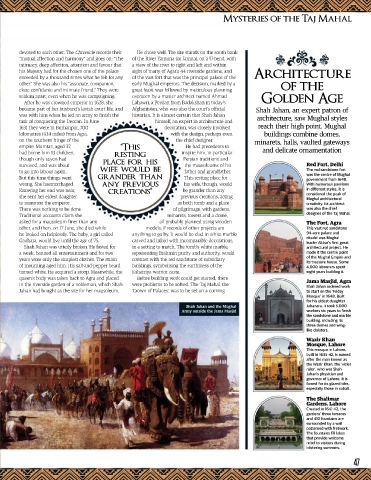
                                                                  Shah Jahan and the Mughal                  Jahanara, it took 5,000
                                                                 Army outside the Jama Masjid                workers six years to finish
                                                                                                             the sandstone and marble
                                                                                                             building, including its
                                                                                                             three domes and wing-
                                                                                                             like cloisters.
                                                                                                             Wazir Khan
                                                                                                             Mosque, Lahore
                                                                                                             This mosque in Lahore,
                                                                                                             built in 1635-42, is named
                                                                                                             after the man known as
                                                                                                             the Wazir Khan, the ‘vizier
                                                                                                             ruler’, who was Shah
                                                                                                             Jahan’s physician and
                                                                                                             governor of Lahore. It is
                                                                                                             famed for its glazed tiles,
                                                                                                             especially those in cobalt.
                                                                                                             The Shalimar
                                                                                                             Gardens, Lahore
                                                                                                             Created in 1641-42, the
                                                                                                             gardens’ three terraces
                                                                                                             and 410 fountains are
                                                                                                             surrounded by a wall
                                                                                                             patterned with fretwork.
                                                                                                             The fountains fill lakes
                                                                                                             that provide welcome
                                                                                                             relief to visitors during
                                                                                                             blistering summers.
                                                                                                                             47
   42   43   44   45   46   47   48   49   50   51   52