


Page 48 - All About History - Issue 27-15
P. 48
Mysteries of the Taj Mahal


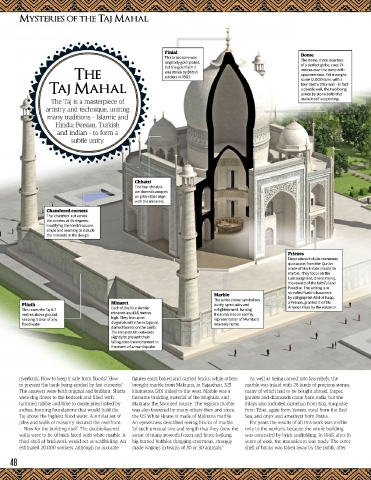
                                                           Finial                                          Dome
                                                           This brass spire was
                                                                                                           The dome, three-quarters
                                                           originally gold-plated,                         of a perfect globe, rises 74
                                                           but the gold from it                            metres over the tomb with
                           The                             was stolen by British                           apparent ease. Yet it weighs
                                                           soldiers in 1803.
                                                                                                           some 12,000 tons, with a
                                                                                                           four-metre thick wall – in fact
                  Taj Mahal                                                                                a double wall, the two being
                                                                                                           joined by stone bolts that
                   TheTajisamasterpieceof                                                                  make it self-supporting.
                 artistry and technique, uniting
                  many traditions – Islamic and
                     Hindu; Persian, Turkish
                     andIndian–toforma
                          subtle unity.


                                                Chhatri
                                                The four chhatris
                                                are domed canopies
                                                on pillars that align
                                                with the minarets.
                 Chamfered corners
                 The ‘chamfers’ cut across
                 the corners at 45 degrees,
                 modifying the tomb’s square
                 shape and seeming to include
                 the minarets in the design.


                                                                                                      Friezes
                                                                                                      Decorations include numerous
                                                                                                      quotations from the Qur’an,
                                                                                                      made of black slate inlaid into
                                                                                                      marble. They focus on the
                                                                                                      Last Judgment, divine mercy,
                                                                                                      the reward of the faithful and
                                                                                                      Paradise. The writing is in
                                                                                                      so-called Naskh characters
                                                                            Marble                    by calligraphist Abd-al Haqq,
                                                                            The white colour symbolises
         Plinth                         Minaret                             purity, spirituality and  a Persian, granted the title
                                                                                                      Amanat Khan by the emperor.
         This raises the Taj 6.7        Each of the four slender            enlightenment, turning
                                        minarets are 41.6 metres
         metres above ground,                                               the tomb into an earthly
         keeping it clear of any        high. They line up on               representation of Mumtaz’s
                                        diagonals with the octagonal,
         flood water.                                                       heavenly home.
                                        domed turrets on the tomb.
                                        The minarets tilt outwards
                                        slightly to prevent them
                                        falling onto the monument in
                                        the event of an earthquake.

        riverbank. How to keep it safe from floods? How   figures exist, baked and carried bricks, while others   As well as being carved into bas-reliefs, the
        to prevent the bank being eroded by fast currents?   brought marble from Makrana, in Rajasthan, 325   marble was inlaid with 28 kinds of precious stones,
        The answers were both original and brilliant. Shafts   kilometres (201 miles) to the west. Marble was a   many of which had to be bought abroad. Jasper,
        were dug down to the bedrock and filled with   favourite building material of the Mughuls, and   garnets and diamonds came from India, but the
        rammed rubble and lime to create piles linked by   Makrana the favoured source. The region’s marble   inlays also included carnelian from Iraq, turquoise
        arches, forming foundations that would hold the   was also favoured by many others then and since:   from Tibet, agate from Yemen, coral from the Red
        Taj above the highest flood water. A similar set of   the US White House is made of Makrana marble.   Sea, and onyx and amethyst from Persia.
        piles and walls of masonry secured the riverfront.   An eyewitness described seeing blocks of marble   For years the results of all this work was visible
          Now for the building itself. The double-layered   “of such unusual size and length that they drew the   only to the workers, because the whole building
        walls were to be of brick faced with white marble. A   sweat of many powerful oxen and fierce-looking,   was concealed by brick scaffolding. In 1648, after 16
        third shell of brickwork would act as scaffolding. An   big-horned buffalos dragging enormous, strongly   years of work, the mausoleum was ready. The outer
        estimated 20,000 workers, although no accurate   made wagons in teams of 20 or 30 animals.”   shell of bricks was taken away by the public after
     48

