


Page 53 - All About History - Issue 27-15
P. 53
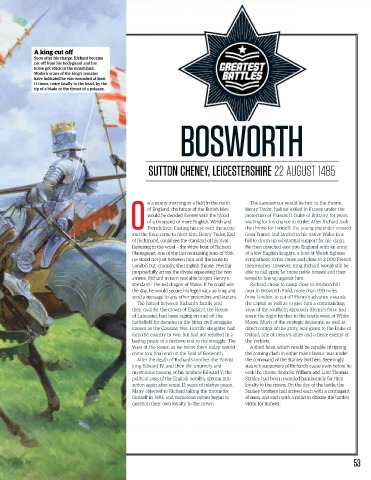
A king cut off
             Soon after his charge, Richard became
             cut off from his bodyguard and his
             horse got stuck in the marshland.
             Modern scans of the king’s remains
             have indicated he was wounded at least
             11 times, twice fatally to the head, by the
             tip of a blade or the thrust of a poleaxe.


                                                                BOSWORTH


                                                     SUTTON CHENEY, LEICESTERSHIRE 22 AUGUST 1485


                                                     n a sunny morning in a field in the north   The Lancastrian would-be heir to the throne,
                                                     of England, the future of the British Isles   Henry Tudor, had sat exiled in France under the
                                                     would be decided forever with the blood   protection of Francis II, Duke of Brittany, for years,
                                                     of a thousand or more English, Welsh and   waiting for his chance to strike. After Richard took
                                               O French lives. Casting his eye over the scene   the throne for himself, the young pretender crossed
                                               and the force come to meet him, Henry Tudor, Earl   from France and landed in his native Wales in a
                                               of Richmond, could see the standard of his rival   bid to drum up substantial support for his claim.
                                               fluttering in the wind – the white boar of Richard   He then marched east into England with an army
                                               Plantagenet, one of the last remaining sons of York.   of a few English knights, a host of Welsh fighters
                                               He stood not just between him and the route to   sympathetic to his cause and close to 2,000 French
                                               London but, crucially, the English throne. Peering   mercenaries. However, King Richard would still be
                                               purposefully across the divide separating the two   able to call upon far more noble houses and their
                                               armies, Richard in turn was able to spot Henry’s   levies to line up against him.
                                               standard – the red dragon of Wales. If he could win   Richard chose to camp close to Ambion hill
                                               the day, he would secure his legitimacy as king and   near to Bosworth Field, more than 100 miles
                                               send a message to any other pretenders and traitors.  from London, to cut off Henry’s advance towards
                                                 The hatred between Richard’s family and   the capital as well as to give him a commanding
                                               their rival for the crown of England, the House   view of the southern approach. Henry’s force had
                                               of Lancaster, had been raging on and off the   spent the night further to the south west, at White
                                               battlefield for decades in the bitter civil struggles   Moors. Much of the strategic decisions, as well as
                                               known as the Cousins’ War. Horrific slaughter had   direct control of the army, was given to the Duke of
                                               torn the country in two, but had not resulted in a   Oxford, one of Henry’s allies and a fierce enemy of
                                               lasting peace or a decisive end to the struggle. The   the Yorkists.
                                               Wars of the Roses, as we know them today, would   A third force, which would be capable of tipping
                                               come to a final end on the field of Bosworth.  the coming clash in either man’s favour, was under
                                                 After the death of Richard’s brother, the Yorkist   the command of the Stanley brothers. Seemingly
                                               king Edward IV, and then the untimely and   staunch supporters of Richard’s cause even before he
                                               mysterious passing of his nephew Edward V, the   took the throne, both Sir William and Lord Thomas
                                               political cogs of the English nobility sprung into   Stanley had been rewarded handsomely for their
                                               action again after some 12 years of relative peace.   loyalty to the crown. On the day of the battle, the
                                               Many objected to Richard taking the throne for   Stanley brothers had arrived each with a contingent
                                               himself in 1483, and numerous nobles began to   of men, and each with a mind to choose the battle’s
                                               question their own loyalty to the crown.   victor for himself.


                                                                                                                             53

