


Page 52 - All About History - Issue 27-15
P. 52
Greatest Battles


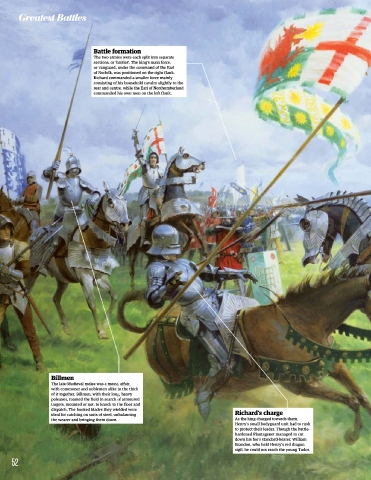
                                  Battle formation
                                  The two armies were each split into separate
                                  sections, or ‘battles’. The king’s main force,
                                  or vanguard, under the command of the Earl
                                  of Norfolk, was positioned on the right flank.
                                  Richard commanded a smaller force mainly
                                  consisting of his household cavalry slightly to the
                                  rear and centre, while the Earl of Northumberland
                                  commanded his own men on the left flank.


                   Billmen
                   The late-Medieval melee was a mess  affair,
                   with commoner and noblemen alike n the thick
                   of it together. Billmen, with their lon , heavy
                   poleaxes, roamed the field in search f armoured
                   targets, mountedornot,toknocktot e floor and
                   dispatch. Thehookedbladestheywielded were
                   ideal for catching on suits of steel, unbalancing                Richard’s charge
                   the wearer and bringing them down.                               As the king charged towards them,
                                                                                    Henry’s small bodyguard unit had to rush
                                                                                    to protect their leader. Though the battle-
                                                                                    hardened Plantagenet managed to cut
                                                                                    down his foe’s standard-bearer, William
                                                                                    Brandon, who held Henry’s red dragon
                                                                                    sigil, he could not reach the young Tudor.
     52

