


Page 36 - World of Animals - Issue #29
P. 36
50 fabulous frogs


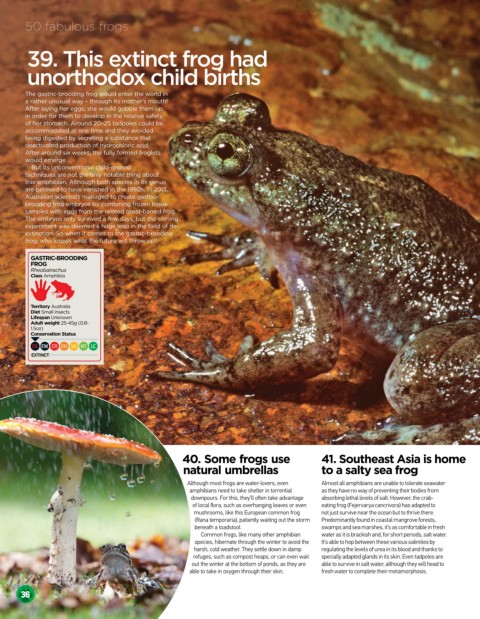
            39. This extinct frog had

            unorthodox child births


            The gastric-brooding frog would enter the world in
            a rather unusual way – through its mother’s mouth!
            After laying her eggs, she would gobble them up
            in order for them to develop in the relative safety
            of her stomach. Around 20–25 tadpoles could be
            accommodated at one time and they avoided
            being digested by secreting a substance that
            deactivated production of hydrochloric acid.
            After around six weeks, the fully formed froglets
            would emerge.
              But its unconventional child-rearing
            techniques are not the only notable thing about
            this amphibian. Although both species in its genus
            are believed to have vanished in the 1980s, in 2013,
            Australian scientists managed to create gastric-
            brooding frog embryos by combining frozen tissue
            samples with eggs from the related great-barred frog.
            The embryos only survived a few days, but the cloning
            experiment was deemed a huge leap in the field of de-

            extinction. So when it comes to the gastric-brooding
            frog, who knows what the future will throw up?

             GASTRIC-BROODING
             FROG
             Rheobatrachus
             Class Amphibia


             Territory Australia
             Diet Small insects
             Lifespan Unknown
             Adult weight 25-45g (0.8-
             1.5oz)
             Conservation Status

              EXTINCT


                                                       40. Some frogs use                    41. Southeast Asia is home
                                                       natural umbrellas                     to a salty sea frog

                                                        Although most frogs are water-lovers, even   Almost all amphibians are unable to tolerate seawater
                                                         amphibians need to take shelter in torrential   as they have no way of preventing their bodies from
                                                         downpours. For this, they’ll o en take advantage   absorbing lethal levels of salt. However, the crab-

                                                         of local flora, such as overhanging leaves or even   eating frog (Fejervarya cancrivora) has adapted to

                                                          mushrooms, like this European common frog   not just survive near the ocean but to thrive there.
                                                          (Rana temporaria), patiently waiting out the storm   Predominantly found in coastal mangrove forests,
                                                          beneath a toadstool.               swamps and sea marshes, it’s as comfortable in fresh
                                                            Common frogs, like many other amphibian   water as it is brackish and, for short periods, salt water.
                                                          species, hibernate through the winter to avoid the   It’s able to hop between these various salinities by
                                                          harsh, cold weather. They settle down in damp   regulating the levels of urea in its blood and thanks to
                                                          refuges, such as compost heaps, or can even wait   specially adapted glands in its skin. Even tadpoles are
                                                         out the winter at the bottom of ponds, as they are   able to survive in salt water, although they will head to
                                                         able to take in oxygen through their skin.  fresh water to complete their metamorphosis.

           36

