


Page 38 - World of Animals - Issue #29
P. 38
Interview with a…

           Marine scientist


            A biological oceanographer at Woods Hole Oceanographic Institution,

            Stace Beaulieu specialises in the mysterious animals of the deep sea

                         What different habitats   sea life range from cabled instruments
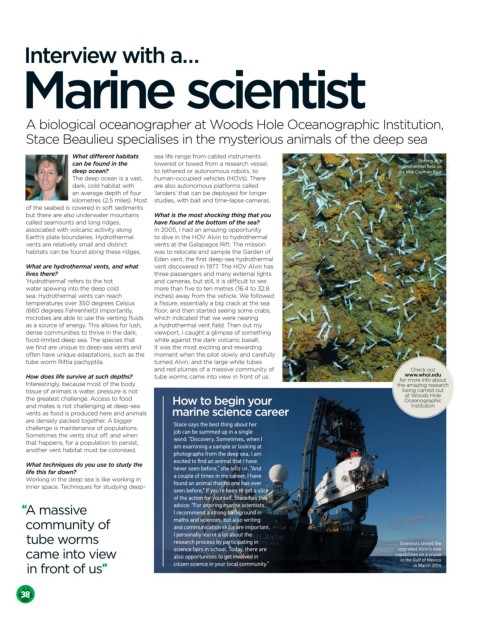
                                                                                                                       Shrimp at a
                         can be found in the   lowered or towed from a research vessel,                          hydrothermal field on

                         deep ocean?           to tethered or autonomous robots, to                               the Mid-Cayman Rise
                         The deep ocean is a vast,   human-occupied vehicles (HOVs). There
                         dark, cold habitat with   are also autonomous platforms called
                         an average depth of four   ‘landers’ that can be deployed for longer
                         kilometres (2.5 miles). Most  studies, with bait and time-lapse cameras.
            of the seabed is covered in soft sediments
            but there are also underwater mountains   What is the most shocking thing that you
            called seamounts and long ridges,   have found at the bottom of the sea?
            associated with volcanic activity along   In 2005, I had an amazing opportunity
            Earth’s plate boundaries. Hydrothermal   to dive in the HOV Alvin to hydrothermal
            vents are relatively small and distinct   vents at the Galapagos Rift. The mission
            habitats can be found along these ridges.  was to relocate and sample the Garden of
                                               Eden vent, the first deep-sea hydrothermal

            What are hydrothermal vents, and what   vent discovered in 1977. The HOV Alvin has
            lives there?                       three passengers and many external lights
            ’Hydrothermal’ refers to the hot   and cameras, but still, it is difficult to see


            water spewing into the deep cold   more than five to ten metres (16.4 to 32.8
            sea. Hydrothermal vents can reach   inches) away from the vehicle. We followed

            temperatures over 350 degrees Celsius   a fissure, essentially a big crack at the sea

            (660 degrees Fahrenheit)! Importantly,   floor, and then started seeing some crabs,
            microbes are able to use the venting fluids   which indicated that we were nearing


            as a source of energy. This allows for lush,   a hydrothermal vent field. Then out my
            dense communities to thrive in the dark,   viewport, I caught a glimpse of something
            food-limited deep sea. The species that   white against the dark volcanic basalt.

            we find are unique to deep-sea vents and   It was the most exciting and rewarding
            often have unique adaptations, such as the   moment when the pilot slowly and carefully
            tube worm Riftia pachyptila.       turned Alvin, and the large white tubes
                                               and red plumes of a massive community of                              Check out
                                                                                                                   www.whoi.edu
            How does life survive at such depths?  tube worms came into view in front of us.                      for more info about
            Interestingly, because most of the body                                                              the amazing research
            tissue of animals is water, pressure is not                                                            being carried out
            the greatest challenge. Access to food   How to begin your                                             at Woods Hole
                                                                                                                   Oceanographic
            and mates is not challenging at deep-sea                                                                 Institution
            vents as food is produced here and animals   marine science career
            are densely packed together. A bigger
            challenge is maintenance of populations.   Stace says the best thing about her
            Sometimes the vents shut off, and when   job can be summed up in a single
            that happens, for a population to persist,   word: “Discovery. Sometimes, when I
            another vent habitat must be colonised.  am examining a sample or looking at
                                                    photographs from the deep sea, I am
                                                    excited to find an animal that I have

            What techniques do you use to study the
            life this far down?                     never seen before,” she tells us. “And
            Working in the deep sea is like working in   a couple of times in my career, I have
            inner space. Techniques for studying deep-  found an animal that no one has ever
                                                    seen before.” If you’re keen to get a slice
                                                    of the action for yourself, Stace has this
           “A massive                               advice: “For aspiring marine scientists,
                                                    I recommend a strong background in
            community of                            maths and sciences, but also writing
                                                    and communication skills are important.
            tube worms                              I personally learnt a lot about the                           Scientists tested the
                                                    research process by participating in
            came into view                          science fairs in school. Today, there are                    capabilities on a cruise
                                                                                                                 upgraded Alvin’s new
                                                    also opportunities to get involved in
                                                                                                                  in the Gulf of Mexico
            in front of us”                         citizen science in your local community.”                         in March 2014
           38

