


Page 8 - Dinosaur (DK Eyewitness Books)
P. 8
What were the dinosaurs?

                                                                                               Opening in skull in front of eye
                                                                                               reduced the weight of the skull
        LȰȯȨ ȢȨȰ  ȴȵȳȢȯȨȦ ȣȦȢȴȵȴ roamed the world.
         Some grew as big as a barn, others were smaller
         than a hen. Some walked on four legs, others on                                                        Neck with
         two. Some were fierce hunters, others were peaceful                                                    S-shaped
                                                                                                                curve
         plant-eaters. These backboned land animals are
         called dinosaurs. Dinosaur means “terrible lizard,”
         and like lizards, dinosaurs were reptiles. But instead of
         sprawling, they walked upright, and some dinosaurs had
         feathers rather than scaly skin. In chilly air, instead of dozing
         like a lizard, some dinosaurs could stay active by generating
         their own body heat. The dinosaurs ruled Earth for
         160 million years—flourishing on land more successfully
         than any other group of backboned animals. Then
         65 million years ago, they mysteriously died out,
         except for one group—the dinosaurs that we call birds.
                                                                              Hole between bones of lower
                                                                              jaw helped to lighten the skull
                            Lung


                                            Cervical air sac
                                            received used air
                                            from the lungs,
                                            ready to be exhaled

                               Abdominal air sac received
                               air inhaled through the
                               nose and throat and
                               supplied it to the lungs


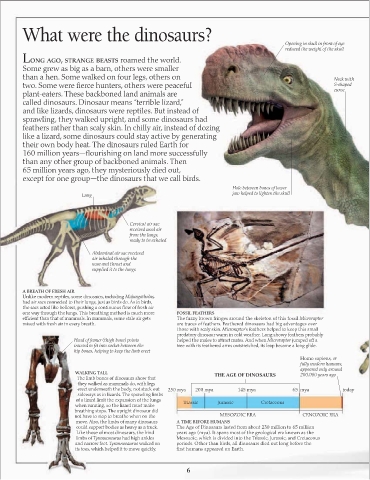
        A BREATH OF FRESH AIR
        Unlike modern reptiles, some dinosaurs, including Majungatholus,
        had air sacs connected to their lungs, just as birds do. As in birds,
        the sacs acted like bellows, pushing a continuous flow of fresh air
        one way through the lungs. This breathing method is much more   FOSSIL FEATHERS
        efficient than that of mammals. In mammals, some stale air gets   The fuzzy brown fringes around the skeleton of this fossil Microraptor
        mixed with fresh air in every breath.               are traces of feathers. Feathered dinosaurs had big advantages over
                                                            those with scaly skin. Microraptor’s feathers helped to keep this small
                                                            predatory dinosaur warm in cold weather. Long showy feathers probably
                          Head of femur (thigh bone) points   helped the males to attract mates. And when Microraptor jumped off a
                          inward to fit into socket between the   tree with its feathered arms outstretched, its leap became a long glide.
                          hip bones, helping to keep the limb erect
                                                                                                    Homo sapiens, or
                                                                                                    fully modern humans,
                                                                                                    appeared only around
                          WALKING TALL                                  THE AGE OF DINOSAURS        200,000 years ago
                           The limb bones of dinosaurs show that
                           they walked as mammals do, with legs
                           erect underneath the body, not stuck out   250 mya  200 mya  145 mya   65  mya         today
                           sideways as in lizards. The sprawling limbs
                          of a lizard limit the expansion of the lungs
                                                             Triassic    Jurassic      Cretaceous
                          when running, so the lizard must make
                          breathing stops. The upright dinosaur did
                          not have to stop to breathe when on the         MESOZOIC ERA               CENOZOIC ERA
                          move. Also, the limbs of many dinosaurs   A TIME BEFORE HUMANS
                          could support bodies as heavy as a truck.   The Age of Dinosaurs lasted from about 230 million to 65 million
                          Like those of most dinosaurs, the hind   years ago (mya). It spans most of the geological era known as the
                          limbs of Tyrannosaurus had high ankles   Mesozoic, which is divided into the Triassic, Jurassic, and Cretaceous
                          and narrow feet. Tyrannosaurus walked on   periods. Other than birds, all dinosaurs died out long before the
                          its toes, which helped it to move quickly.  first humans appeared on Earth.


                                                               6

