


Page 10 - Dinosaur (DK Eyewitness Books)
P. 10
Different designs


        PȢȭȦȰȯȵȰȭȰȨȪȴȵȴ ȥȪȷȪȥȦ ȥȪȯȰȴȢȶȳȴ ȪȯȵȰ two groups,
         according to how their hip bones are arranged. Most
         saurischians had hip bones like a lizard’s and were
         two-legged, meat-eating theropods, or four-legged,
         plant-eating sauropods. The ornithischians had hip
         bones like a bird’s and were plant-eaters. They included
         two-legged ornithopods, as well as plated, armored, and
         horned dinosaurs, which were all four-legged. Bony plates
         or spikes ran along the backs of stegosaurs, or plated dinosaurs,
         and bony body armor protected the ankylosaurs, or armored
         dinosaurs. Ceratopsians, or horned dinosaurs, bore horns on
         their heads and bony frills over their necks. The family tree
         on pages 64–65 shows how all these dinosaurs were related.

        Hip bones face in
        different directions             Hip bones lie next
                                         to each other
                                                                          Immense
                                                                          bony
                               Gallimimus                                 neck frill
                               (a saurischian)

                                                             Heterodontosaurus
                                                             (an ornithischian)


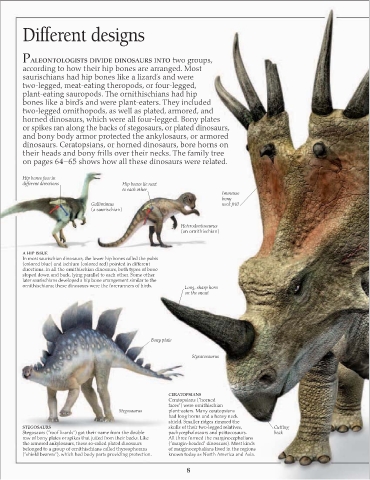
        A HIP ISSUE
        In most saurischian dinosaurs, the lower hip bones called the pubis
        (colored blue) and ischium (colored red) pointed in different
        directions. In all the ornithischian dinosaurs, both types of bone
        sloped down and back, lying parallel to each other. Some other
        later saurischians developed a hip bone arrangement similar to the
        ornithischians; these dinosaurs were the forerunners of birds.  Long, sharp horn
                                                              on the snout


                                                   Bony plate

                                                                Styracosaurus


                                                         CERATOPSIANS
                                                         Ceratopsians (“horned
                                                         faces”) were ornithischian
                                        Stegosaurus      plant-eaters. Many ceratopsians
                                                         had long horns and a heavy neck
                                                         shield. Smaller ridges rimmed the
        STEGOSAURS                                       skulls of their two-legged relatives,   Cutting
        Stegosaurs (“roof lizards”) got their name from the double  pachycephalosaurs and psittacosaurs.    beak
        row of bony plates or spikes that jutted from their backs. Like   All three formed the marginocephalians
        the armored ankylosaurs, these so-called plated dinosaurs   (“margin-headed” dinosaurs). Most kinds
        belonged to a group of ornithischians called thyreophorans   of marginocephalians lived in the regions
        (“shield bearers”), which had body parts providing protection.  known today as North America and Asia.

                                                               8

