


Page 24 - (DK Eyewitness) Travel Guide - Sydney
P. 24
22 INTRODUCING SY DNEY
Sydney’s Original Inhabitants
Anthropologists believe that Aboriginal peoples reached
Sydney Harbour at least 50,000 years ago. One of the clans
of coastal Sydney was the Eora people. Their campsites were
usually close to the shore, particularly in the summer when
fish were plentiful. Plant and animal foods supplemented
their seafood diet. Artistic expression was a way of life, with
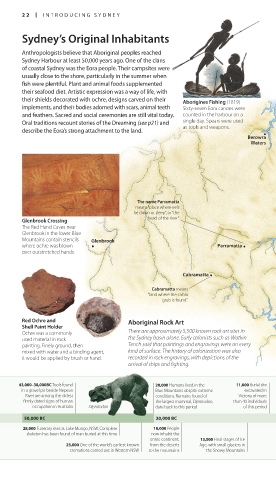
their shields decorated with ochre, designs carved on their Aborigines Fishing (1819)
implements, and their bodies adorned with scars, animal teeth Sixty-seven Eora canoes were
and feathers. Sacred and social ceremonies are still vital today. counted in the harbour on a
Oral traditions recount stories of the Dreaming (see p21) and single day. Spears were used
as tools and weapons.
describe the Eora’s strong attachment to the land.
Berowra
Waters
The name Parramatta
means “place where eels
lie down or sleep”, or “the
head of the river”.
Glenbrook Crossing
The Red Hand Caves near
Glenbrook in the lower Blue
Mountains contain stencils Glenbrook
where ochre was blown Parramatta
over outstretched hands.
Cabramatta
Cabramatta means
“land where the cobra
grub is found”.
Red Ochre and Aboriginal Rock Art
Shell Paint Holder
Ochre was a common ly There are approximately 5,500 known rock art sites in
used material in rock the Sydney basin alone. Early colonists such as Watkin
painting. Finely ground, then Tench said that paintings and engravings were on every
mixed with water and a binding agent, kind of surface. The history of col onization was also
it would be applied by brush or hand. recorded in rock engravings, with depictions of the
arrival of ships and fighting.
43,000–38,000BC Tools found 20,000 Humans lived in the 11,000 Burial site
in a gravel pit beside Nepean Blue Mountains despite extreme excavated in
River are among the oldest conditions. Remains found of Victoria of more
firmly dated signs of human the largest mammal, Diprotodon, than 40 individuals
occupation in Australia Diprotodon date back to this period of this period
50,000 BC 20,000 BC
28,000 Funerary rites at Lake Mungo, NSW. Complete 18,000 People
skeleton has been found of man buried at this time now inhabit the
entire continent, 13,000 Final stages of Ice
23,000 One of the world’s earliest known from the deserts Age, with small glaciers in
cremations carried out in Western NSW to the mountains the Snowy Mountains
022-023_EW_Sydney.indd 22 29/05/17 12:18 pm

